Easily one of the most misunderstood parts out there. Folks use them as a magic dust to sprinkle it here and there in the circuit without really understanding its use case. These are very specific, frequency-dependent resistors that you place on purpose, and only after you know what noise you are after. Let’s discuss this today.
A ferrite bead is a small piece of ferrite ceramic with a conductor through it. In most SMD beads, it’s built as multiple layers of ferrite with metal electrodes, arranged, so the current still passes through ferrite material along its path.
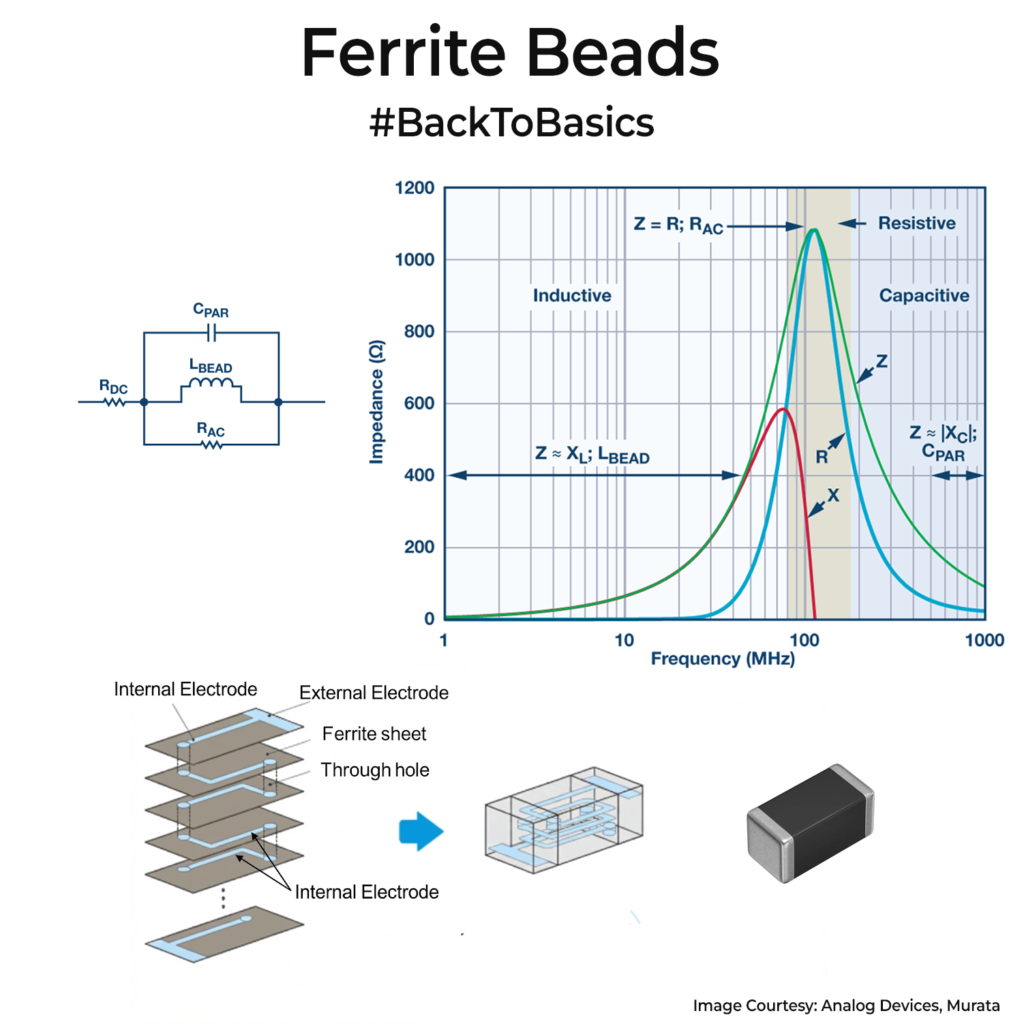
At DC and low frequency, it looks almost like a short (10-300 mΩ range). As frequency rises, its impedance rises first because of inductance. Then the ferrite losses kick in, and the impedance becomes mostly real resistance, so RF energy turns into heat. At still higher frequency, the parasitic capacitance dominates, and the impedance falls again. That is why you see datasheet impedance curve has a hump.
You use beads when you want to block high-frequency noise without isolating DC. Common cases are splitting a noisy digital 3.3V rail from a quieter analog 3.3V rail, feeding an RF block, cleaning up sensor power, or removing EMI on a cable line together with a shunt capacitor(Check older posts for more details on this).
A ferrite bead datasheet usually starts with a headline like “600Ω @ 100MHz”. That number is the bead’s impedance measured at one test frequency, and the graph beside it shows the full impedance vs frequency curve. Use that curve to match your noise band. If your noise issue is at 10MHz or 500MHz, adding this ferrite bead is useless. To find your noise band, use a near-field probe or spectrum analyser to see the spikes.
Also watch the DC bias. A 1A load can push the ferrite toward saturation and cut the impedance drastically. Also ensure that the ferrite bead can handle the heat when a large current passes through it. It will cause a voltage drop in the rail too. Most people forget to size the bead it correctly for power.
0 Comments
Comments are closed.