There has been a lot of hue and cry around AI data centers. I think a good part of it is valid, because big ones can stress the local power grid and water systems. The energy side is harder to solve as every calculation needs electricity. The water side is more interesting, because water is often used to move heat. Let’s discuss the latest tech trying to reduce that.
From the basics, almost every watt entering a server becomes heat. A 100kW AI rack is close to a 100kW heater. If you remove heat using air, you need airflow, fans, cold aisles and chilled water. Traditional cooling often uses an open or semi-open evaporative path. Water takes heat from the chiller loop and some of it is intentionally evaporated in a cooling tower. This works because evaporation carries a lot of heat. Water demand can peak on hot days when cities and farms also need water.
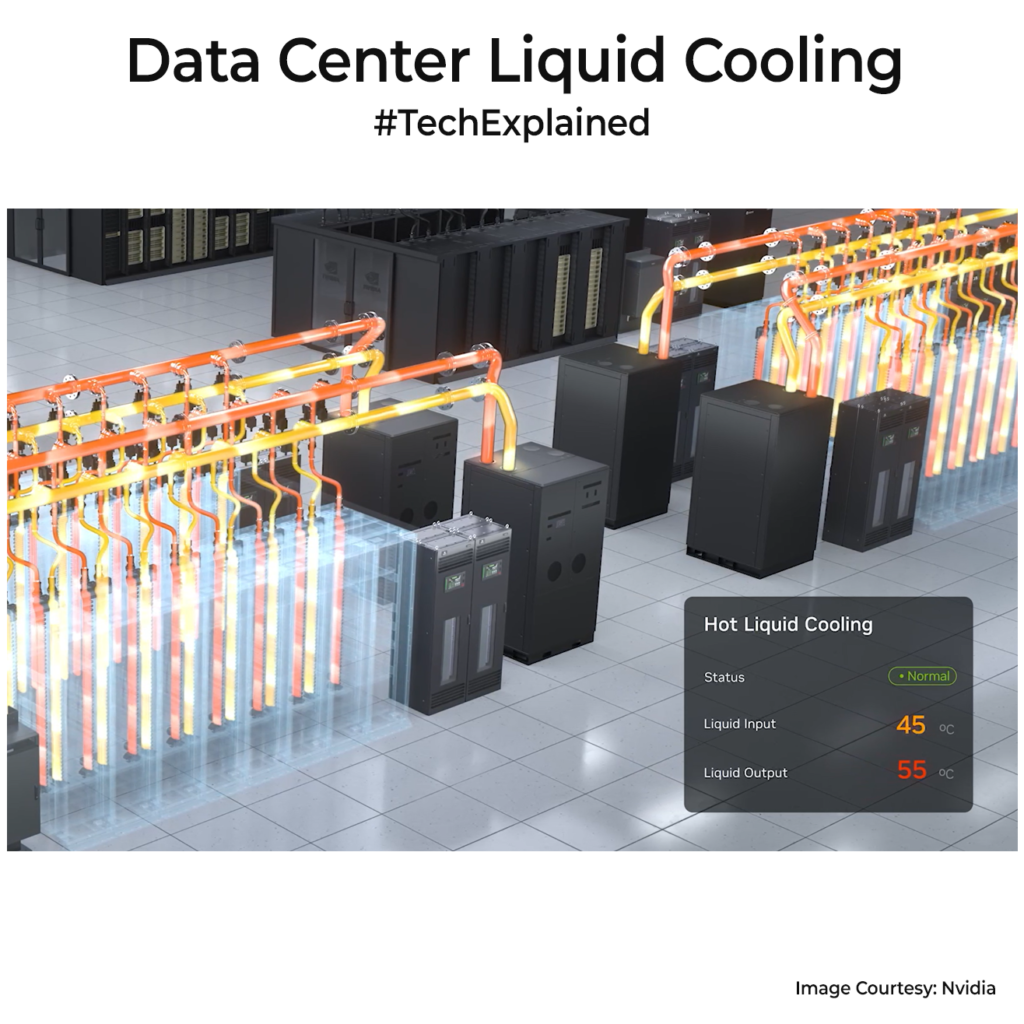
In a closed-loop system, a water-glycol coolant flows through cold plates on the chips, picks up heat, goes to a coolant distribution unit, then to a dry cooler that works like a radiator. The same coolant keeps circulating. NVIDIA’s reference talks about 45°C coolant going in and roughly 55°C coming out. That higher temperature loop matters because warmer coolant creates a larger temperature difference with ambient air, improving heat transfer in dry coolers and reducing the need for water-intensive cooling towers.
Microsoft, Google and Meta have been pushing liquid cooling and higher temperature operation for the same reason. Recent lifecycle work suggests advanced cooling can cut total water use by roughly 31-52% versus traditional air cooling. An NVIDIA white paper says cooling-tower-based systems can use about 10 Million litres per MW-year, while warm liquid loops with dry coolers can bring that close to zero in good climates. So good from the local nature PoV.
I think this should be considered by every new data center being planned now. A site already built around air cooling or evaporative towers may carry that architecture for years, but new builds still have the chance to choose a lower-water heat path from day one. I hope India follows the newer tech.
0 Comments
Comments are closed.