Earlier this week, I watched a fascinating TechTechPotato deep dive on advanced lithography. I recommend it if you have the time. Researchers have explored X-ray lithography for more than five decades, yet it has never entered mainstream chip production. Let me try throwing some light there.
Lithography transfers circuit patterns onto a light-sensitive resist on a silicon wafer. Today’s leading-edge systems use extreme ultraviolet, or EUV, light at 13.5nm. Conventional EUV optics have a numerical aperture of 0.33. High-NA EUV raises this to 0.55 and can resolve features around 8nm, but the scanner, masks and process control become harder. As features shrink further, manufacturers may again need multiple exposures for one layer. Shorter wavelengths provide another route. Moving towards 6-7nm radiation(called the Xray range) could offer finer resolution at the same numerical aperture and reduce some multi-patterning.
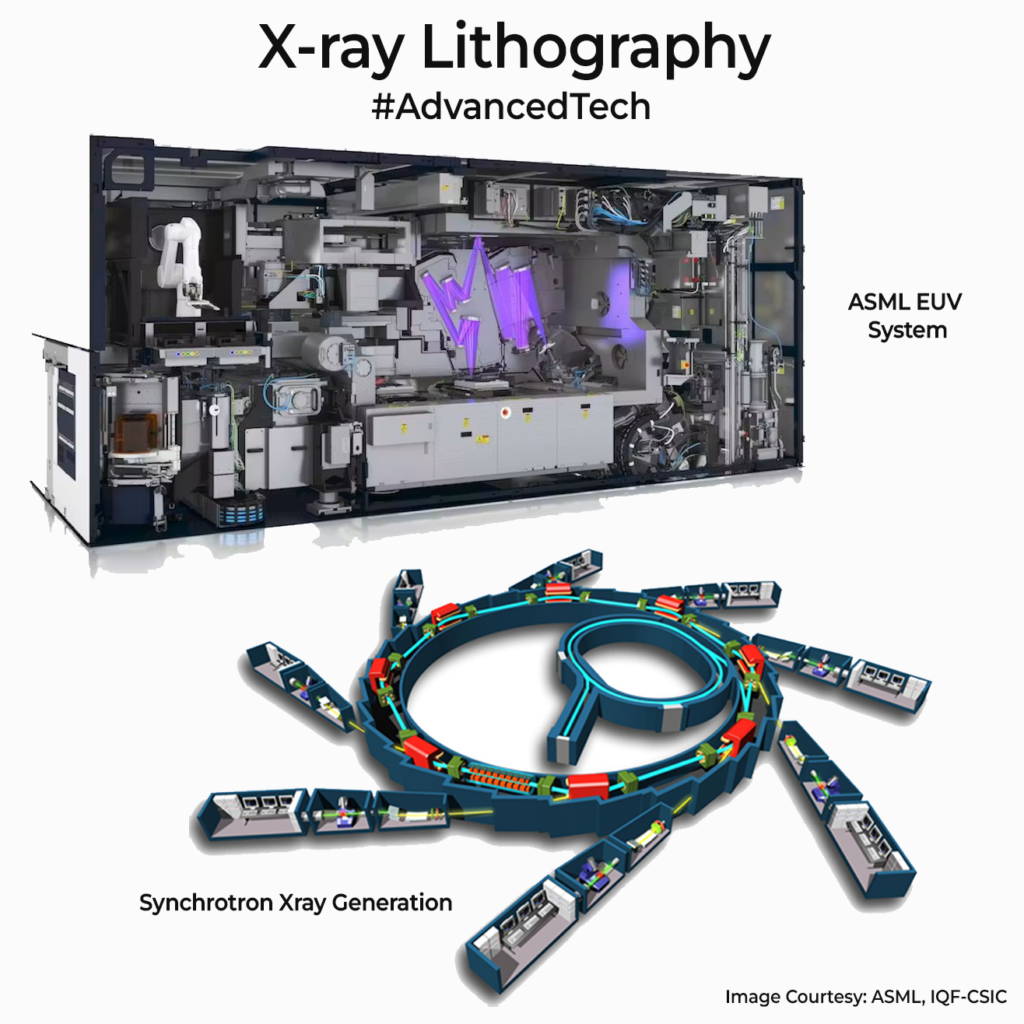
The trade-off starts with photon energy. A 13.5nm EUV photon carries about 92eV, while a 6.7nm photon carries about 185eV. At the same exposure dose, you therefore receive roughly half as many photons. That increases random variations in exposure, while higher-energy secondary electrons can spread through the resist and blur feature edges. The system also needs a powerful, stable source, efficient reflective optics, durable masks and near-nanometre overlay across many layers.
X-ray lithography has produced fine patterns and even functional circuits in research settings, but production tool must repeat the process across full 300mm wafers with extremely low defect density, precise overlay, high uptime and competitive throughput. Current EUV systems output around 230 wafers/hour. No commercial X-ray lithography platform currently operates in high-volume chip manufacturing. I think it remains a credible long-term frontier, but breakthroughs are still required across the board. For now, ASML’s EUV platform still remains the production benchmark.
0 Comments
Comments are closed.