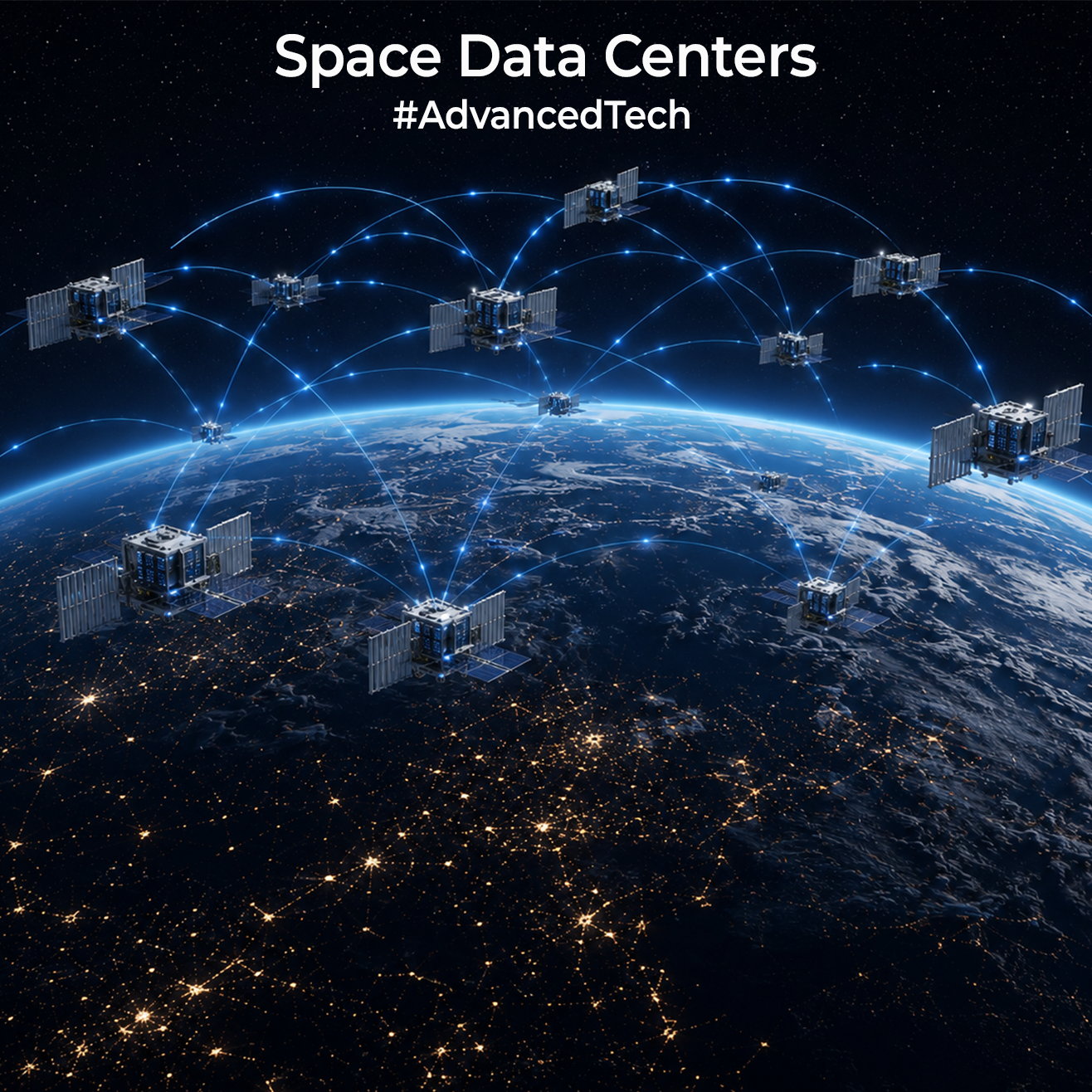
There is a lot of buzz in this literal “space” about moving data centers into orbit. Space sounds cold, so it may seem like a cooling engineer’s dream. But I think this is one of the most misleading parts of the pitch.
A processor converts almost all its electrical power into heat. A 1 MW AI cluster therefore produces roughly 1 MW of waste heat. On Earth, air or water carries it to chillers, cooling towers or dry coolers. In vacuum, no surrounding fluid carries heat away. You must conduct it from the chips into cold plates and liquid loops, then spread it across radiators that emit infrared energy into space.
Radiated power follows the Stefan-Boltzmann law. It rises with radiator area and the fourth power of temp. It’s estimated that a 40 kW AI rack would need about 80 m² of radiator near 60 °C, facing deep space. At 100 MW, that becomes roughly 0.2 km². At 1 GW, it approaches 2 km², before degradation.
Now running a radiator hotter reduces its required area (though efficiency drops). But heat must flow from a hotter chip to cooler liquid and then to the radiator. Higher temperatures increase leakage, can reduce compute efficiency and shorten component life. Radiators should also face away from sunlight while solar arrays face the Sun, complicating plumbing and attitude control.
This cooling system is far from free. Radiators, pumps, pipes and coolant loops must be built, folded into a rocket, launched, deployed and protected against micrometeoroids, orbital debris, atomic oxygen and surface degradation. The same analysis estimates that coating degradation over five years could require about 40% more radiator area.
Cooling alone does not make orbital computing impossible. But it joins launch cost, radiation, high-bandwidth networking, maintenance and rapid chip obsolescence as reasons space-based AI data centers do not yet make financial sense. I can cover the other issues, with estimated numbers, in a future post. I do hope that more of this investment is directed toward R&D for more pressing problems in the world.
0 Comments
Comments are closed.