A few months ago around CES, I wrote about Donut Lab’s “all-solid-state” battery. I was skeptical then, but wondered whether some surface-storage or capacitor-like mechanism could explain its claims. A lot has happened since then. So I owe it to whoever reads my posts an update on that.
Donut commissioned Finland’s VTT institute to test its cells. The results show there is a real rechargeable battery here. It held charge for 10 days, so the super capacitor theory looks unlikely. VTT also measured 0–80% charging in about 4.5 minutes at 11C, although a full charge took roughly 7–8 minutes.
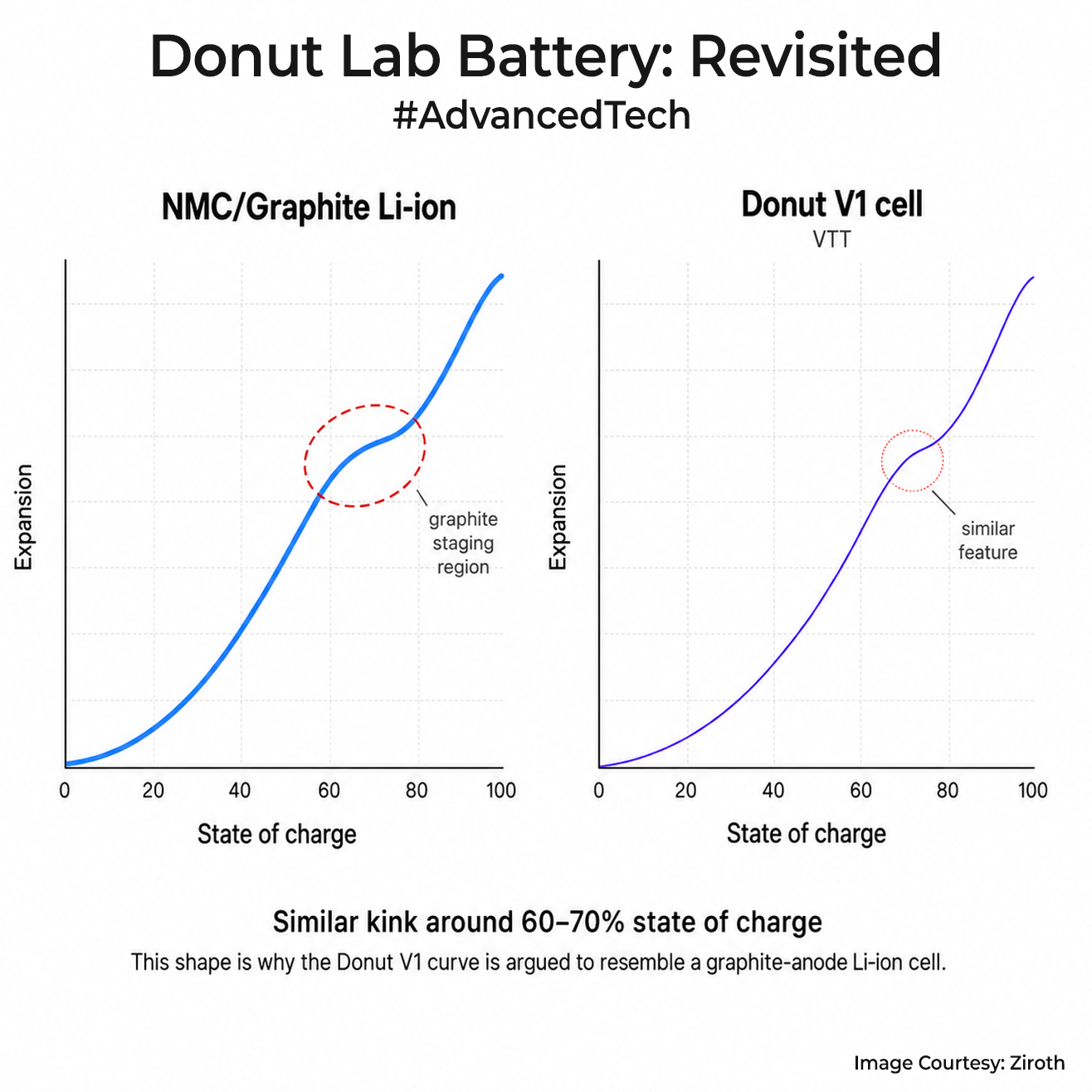
Then Ryan@Ziroth did a detailed investigation with more than 20 battery experts. Their strongest clue is in Donut’s own VTT data. The voltage curve looks similar to high-nickel lithium-ion, while the measured cell expansion has a distinctive shape associated with lithium entering a graphite anode(Check Pics). I think the evidence that the tested cell is lithium-based is now quite strong.
The bigger issue is what VTT has not verified. Donut still claims 400Wh/kg and a design life of 100,000 cycles. VTT has independently measured neither. Thats where the problem lies.
And 400 Wh/kg alone is no longer a science fiction. Amprius Tech publishes silicon-anode lithium-ion cells around 400–450 Wh/kg(Will deep dive on this some other day). Those cells make different compromises on power and cycle life, but they show why energy density alone cannot prove exotic chemistry.
Donut Lab rejects Ziroth’s conclusions and says it stands behind its technology. For me, I think consensus is shifting to Donut’s claims being borderline false, on a good number of items. They are still not releasing a product or any serious data to back it up. It is getting close to vaporware territory. Will see how this goes ahead.
Battery tech in EVs is moving very quickly though. Even mature chemistries like LFP are being pushed to limits by folks at BYD. That’s worth looking into soon as well if there is interest.
0 Comments
Comments are closed.