Earlier this week I was chatting with a friend about NFC tags for his project. He needed tamper-evident labels, and I realised these stickers were more complex than I assumed.
An NFC inlay has an IC and antenna on thin film. Your phone powers it through a 13.56 MHz magnetic field. In a fragile security label, peeling breaks the antenna and the tag stops responding. That approach is cheap and useful for one-time seals, but a dead tag cannot explain why it stopped working. Poor placement, metal near the antenna or a damaged chip can also make it unreadable. Some labels keep the NFC antenna intact and add a second, sacrificial conductive loop across the opening.
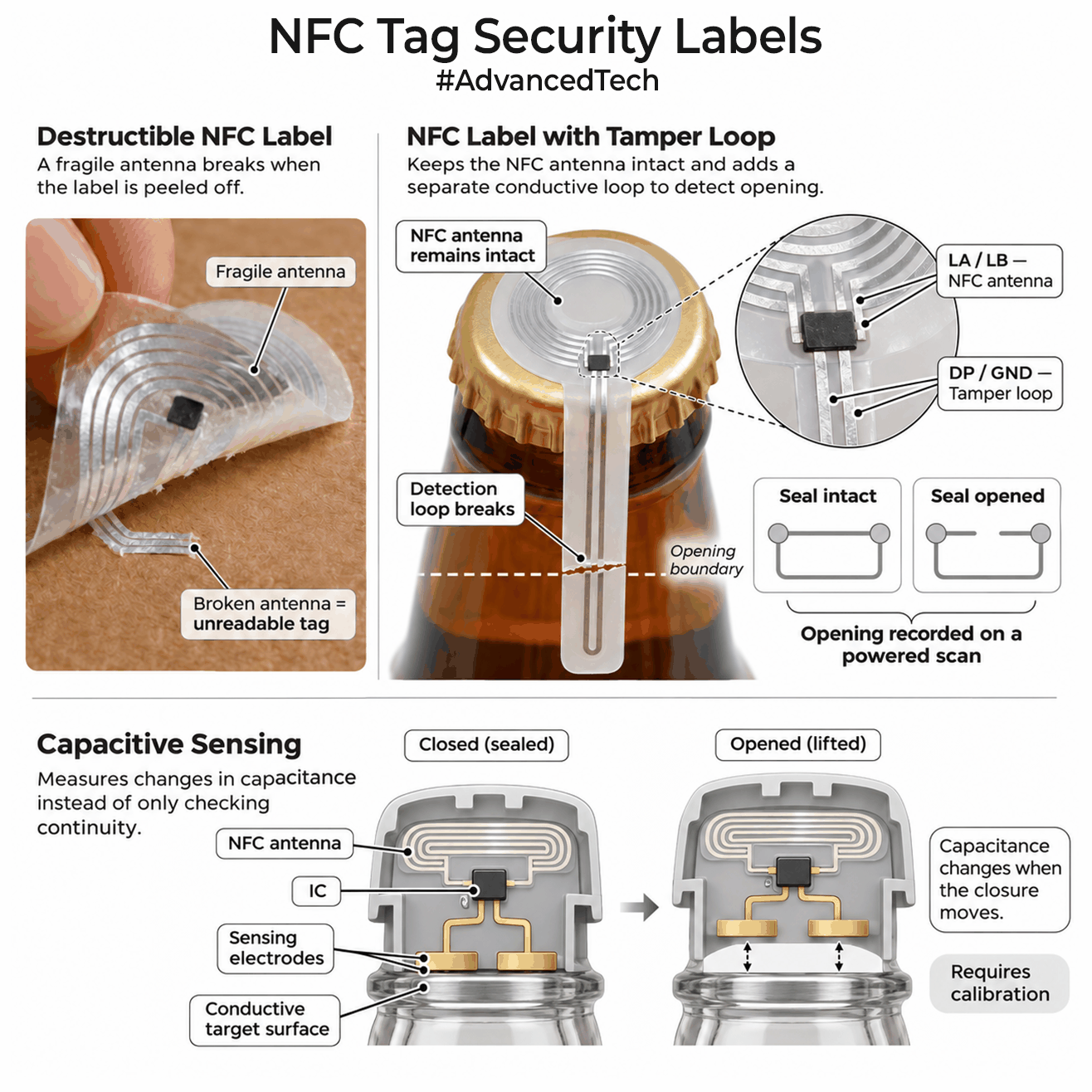
With chips such as NXP’s NTAG213 TT, that second loop connects to dedicated detection pins. When the package is opened, the loop breaks. On the next scan, the antenna powers the IC, which can report the open state and permanently store an observed tamper event. The same tag can continue linking to product details after opening.
There are also capacitive versions, such as NXP’s NTAG223/224 DNA StatusDetect. They measure changes in capacitance rather than only checking continuity. These suit closures where an extra breakable wire is awkward, but need calibration for the actual packaging and environment.
You have to understand and remember this, these are passive tags with no battery. They check the sensor when a phone or reader powers them. If someone opens and restores the loop between scans, the chip may never see it. A torn physical seal can preserve that evidence, which is why antenna layout, adhesive and substrate matter as much as the IC.
For expensive goods, cryptographic NFC tags can also help verify that the tag itself is genuine. That is separate from proving the seal was untouched. I think the best design starts by asking what evidence you need after opening, and whether the tag must remain readable.
0 Comments