Advanced Tech: Microfluidic cooling

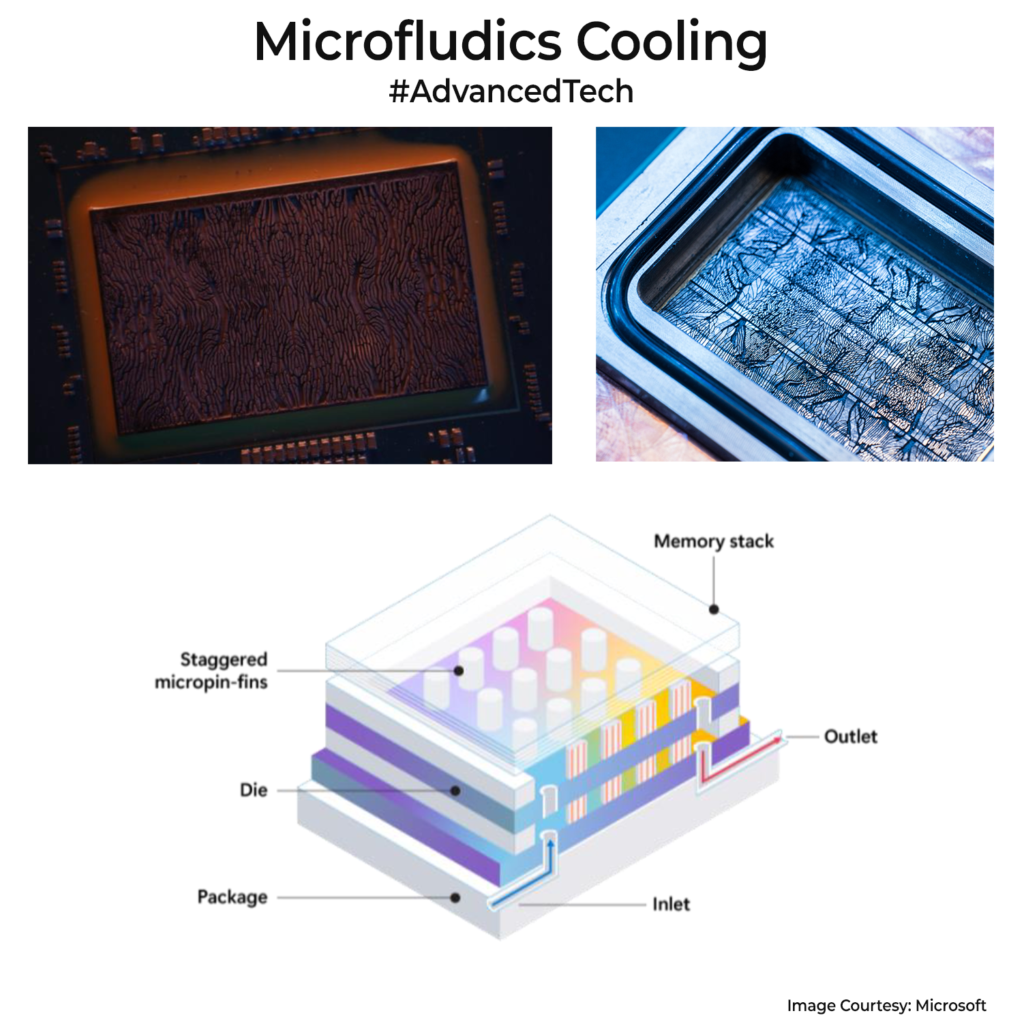
During some reading, I came across a cooling technology Microsoft published a few months back, and it felt somehwat more interesting than the usual “AI hardware” headline. The work focuses on cooling directly into the silicon itself.

To understand why this is important, we need to understand how chips are cooled today. Most high-power processors rely on cold plates where coolant flows through channels above the package, while heat still has to travel through silicon, thermal interfaces and packaging layers before reaching the liquid. So additional layers adds thermal resistance, and as chip power density keeps increasing, cooling becomes a bottleneck.

What Microsoft is exploring are microfluidic channels etched directly into the back of the silicon so coolant moves much closer to hotspots on the die. The interesting part for me is the leaf-like channel structure they discussed. Chips do not heat uniformly, so a simple straight-channel layout is inefficient. A branching structure inspired by leaf veins distributes coolant more intelligently toward hotter regions while avoiding unnecessary flow elsewhere. I think they modeled channels with some AI patterning customized to each chip based on the heat produced, mimicking how leaf veins move water/nutrients via branching.

In Microsoft’s lab-scale testing, this reportedly improved heat removal by up to 3x compared to conventional cold plates and reduced maximum GPU silicon temperature rise by as much as 65%, although I would still treat these as controlled research numbers rather than production ones.

Training and inference clusters already consume massive power. Data centres used ~486 TWh in 2025. In inefficient setups, cooling alone can cross 30%, about 146 TWh, enough to power ~12.5 crore Indian homes for a year.

I think the solution in its current format would have reliability issues. Moving coolant this close to silicon introduces risks around clogging, leakage & pressure balance. A tiny blockage inside microscopic channels can impact an entire hotspot region. It might be a while before this rolls out in production.

If you liked the post, Share it with your friends!

Advanced Tech: Ghost Murmur

You might have seen news a few weeks back about the rescue of a US pilot from Iran. Then came a media post from NewYorkPost about Ghost Murmur, a device that supposedly helped find him by detecting his heartbeat 60km away. There was a lot being said about it. I wanted to see if this was scientifically possible. It’s defense tech, so this will be slightly speculative from my end.

The claim made is that your heart creates a tiny magnetic field when current flows through it. A sensor picks it up and an “AI” software filters the noise and looks for a heartbeat pattern.

I deep-dived into it. There was a base technology that kind of enables it. It’s called Quantum Magnetometry. This was shown with NV centers in diamond. NV means nitrogen-vacancy. In simple terms, one carbon atom in diamond is replaced by nitrogen, and the neighbouring carbon atom is empty. When you shine laser light and apply microwaves, its quantum state changes slightly with the magnetic field around it. By reading that change in light, the diamond can act like a very sensitive magnetic-field probe.

So the probing tech is real. Many research groups work on NV-diamond magnetometry, and heart magnetic signals are also real. But heartbeat magnetic field is a very weak near-field signal. Near the chest, it may be in the picoTesla range, which is already tiny. A picoTesla is one trillionth of a Tesla. For reference, Earth’s magnetic field is usually around 25-65 microtesla.

And once you move away, that signal drops very fast. So I highly doubt they have somehow magically solved the problem that it survived kilometres of air, terrain and Earth’s magnetic field. They claim AI software, but AI can kick in only if the data capture is possible. So detecting one human heartbeat from 60 km away feels extremely unlikely based on public physics. I do think the claim is an overexaggeration from someone either to mislead or oversell.

Realistically it might be a sensor fusion. Maybe like a rescue beacon, GPS burst, thermal imaging and maybe some magnetic sensing all feeding one system.

What do you folks think?

If you liked the post, Share it with your friends!
1 2 3 4 5