I recently had to interact with a client specifically regarding Class X and Class Y capacitors, and I thought it will be a good refresher for the community as well.
These 2 caps are mostly used in the AC circuits. Class X sits across Line and Neutral and helps remove differential mode noise. Class Y connects from Line or Neutral to protective earth, or across the isolation barrier, to drain common mode noise safely. “X” and “Y” names are got from the international capacitor safety standard IEC 60384-14 for capacitors.
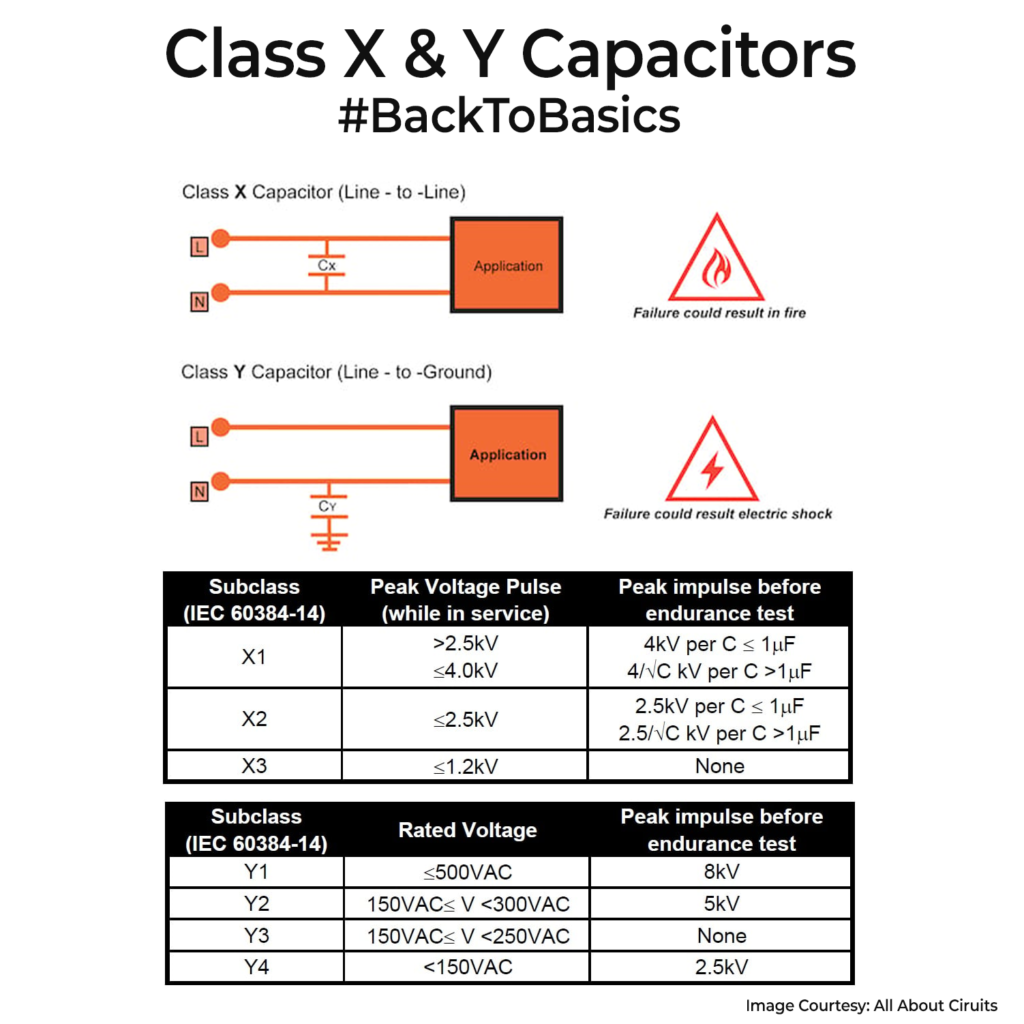
An across-the-line failure can cause fire, so X capacitors are built to be self-healing, pass surge and flammability tests. A line-to-earth failure could make exposed metal live and cause electric shock, so Y capacitors must fail open and are limited in capacitance to keep leakage current small.
There are subclasses. X parts are X1 and X2. X2 is the common choice for normal mains surges, X1 is for harsher industrial projects. Y parts are Y1 and Y2. Y2 goes from Line or Neutral to earth in Class I gear. Y1 is used when you bridge reinforced insulation across the isolation barrier. Pick only parts with safety marks like UL on the datasheet and body. Keep Y values small and check leakage current with I ≈ 2πfVC so the total stays within your power budget.
Think about tradeoffs. X caps can be larger and cut more differential noise, but they need discharge parts and space. A bleeder resistor is needed across the X capacitor to make sure you don’t get a shock after unplugging the AC. Typically, in 1-5MΩ range. Y caps keep users safe by failing open and by being small, but they add leakage, so values are limited.
Remember that many Y MLCCs lose capacitance with DC bias so leave margin or pick C0G or film. In humid regions, choose parts that pass 85C and 85% RH tests. Never replace safety capacitors with general purpose parts on the mains(I can’t stress this enough!).
0 Comments
Comments are closed.