There has been a lot of discussion around E20 fuel being rolled out across India. One side says it is cleaner and better for emissions. Another side says it hurts mileage. I wanted to look at the cleaner-fuel claim from a science point of view just for my understanding as there is lot of misinformation around.
The useful question is simple. Cleaner in what sense?
E20 can be cleaner if you are talking about some local pollutants from the exhaust. It looks less dramatic if you are talking about tailpipe CO₂ per km. It can look better again if you use lifecycle carbon accounting, where farming, fertilizer, irrigation, distillation, transport, and fuel production are included.
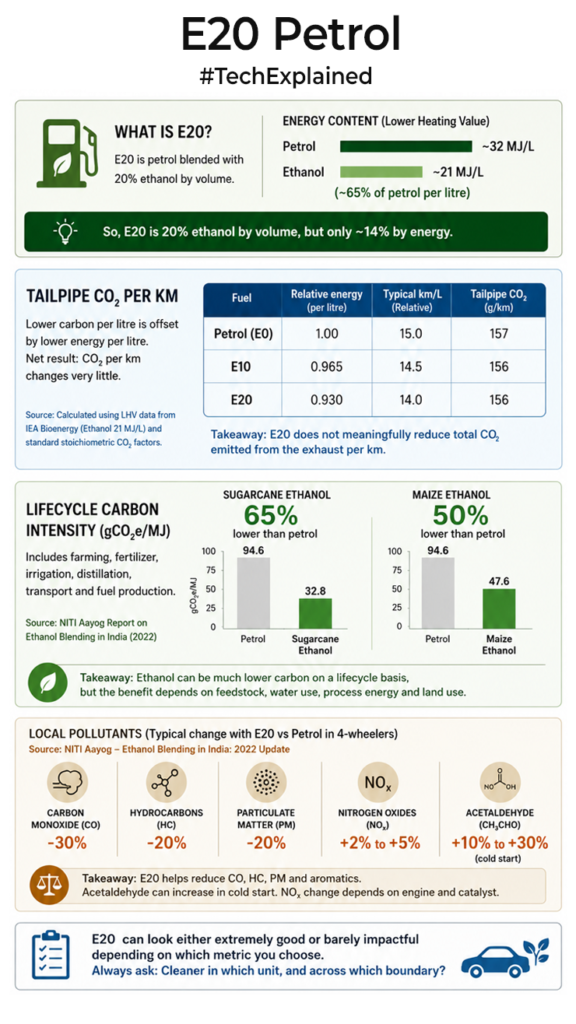
E20 means petrol blended with 20% ethanol by volume. Ethanol still burns to produce CO₂ and water. It has less carbon per litre than petrol, but it also has less energy per litre. A good rule of thumb is that ethanol carries about 65% of petrol’s energy per litre. So E20 is 20% ethanol by volume, while ethanol contributes only about 14% of the fuel energy.
This is where many claims become confusing. If a certain ethanol pathway has 50% lower lifecycle emissions than petrol, the full E20 blend does not become 50% lower carbon. Only a fraction of the fuel energy is coming from ethanol, so the blend-level climate benefit becomes much smaller. For tailpipe CO₂ per km, the saving is also limited because lower carbon per litre is partly offset by lower energy per litre. Mileage drops.
The stronger case for E20 is local pollution. Ethanol has oxygen in the molecule, so it can help reduce carbon monoxide, soot & particulate matter. The tradeoff is that acetaldehyde can increase, especially during cold start, and NOₓ depends on engine design and catalyst behaviour.
Based on all of this, it is surprisingly easy to make E20 look either extremely good or completely pointless depending on which metric you choose to highlight. So before accepting any claim about E20 being cleaner or dirtier, the first question should be: cleaner in which unit, and measured across which boundary?
Once you ask that question, most of the confusion around E20 starts to disappear and you can take an informed decision.
0 Comments
Comments are closed.