Today, let’s discuss AMR sensors. These sensors are still relatively new to many embedded builders because you mostly find them in motors, steering systems, actuators and industrial encoders. I thought it is worth covering for newer folks.
AMR means Anisotropic Magneto-Resistance. A thin magnetic film changes its resistance based on the direction of the magnetic field around it. So an AMR angle sensor is mostly asking which way the field is pointing, rather than only asking how strong the magnet is. Inside the chip, that resistance change is arranged as Wheatstone bridges. Think of them as tiny resistor networks that turn a small resistance shift into a voltage. With a rotating diametric magnet above the sensor, the outputs become sine and cosine signals. The MCU or the chip itself then calculates angle from those signals.
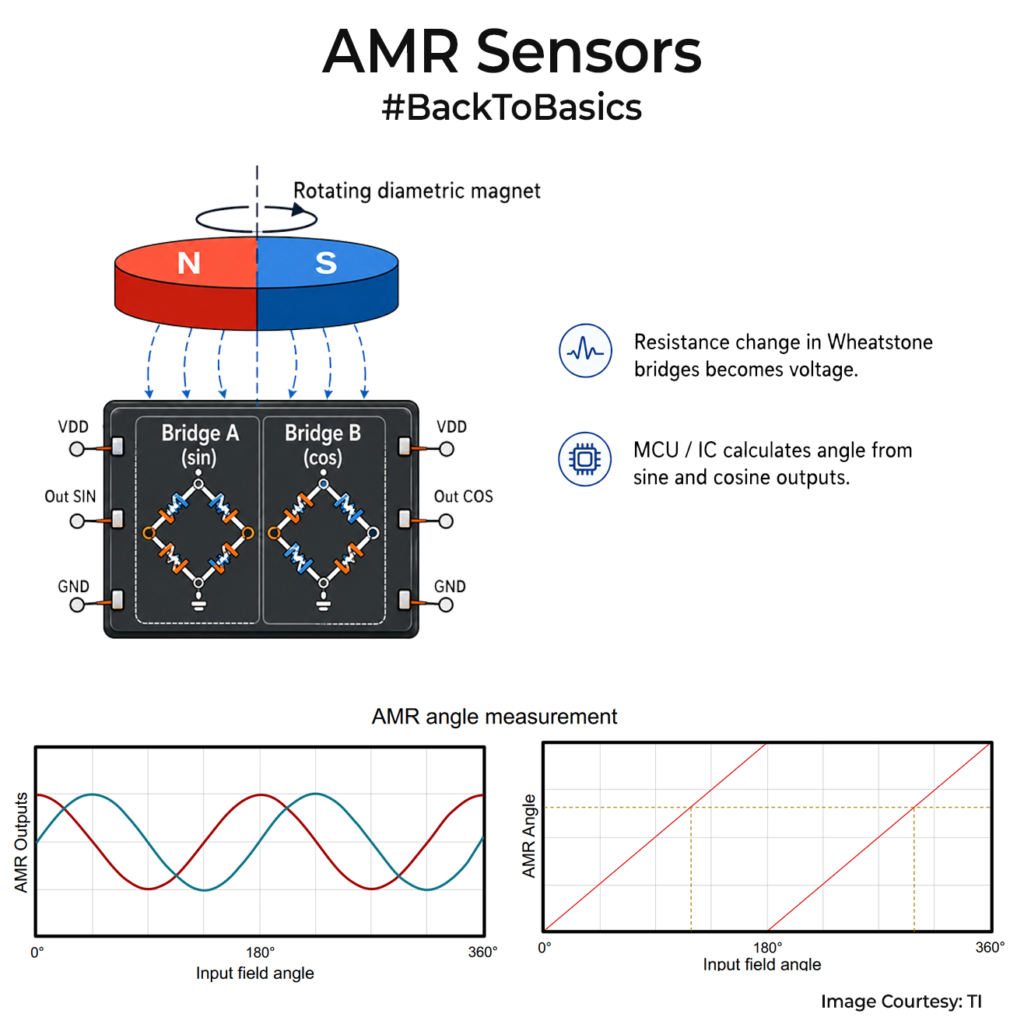
A basic AMR angle sensor repeats every 180°. It cannot naturally tell whether the magnet is at 30° or 210°. For full 360°, modern ICs they add Hall effect information. TI’s TMAG6180-Q1 mixes AMR with Hall quadrant outputs. Analog Devices’ ADMT4000 combines AMR with GMR(Giant magnetoresistance) for 360° and multiturn tracking.
Accuracy is where AMR becomes useful. Some have around 0.25°-0.5° angular error. These results depends on magnet centering, air gap, temperature, ADC quality and calibration though so expect that result always.
You will see AMR as angle sensors, linear position sensors and magnetic switches. Its usually used for motor rotor position, robotic joints, valves, e-bike motors, steering angle and compact encoders. AMR sensors can offer very good signal-to-noise performance and fast response times, making them attractive for high-speed control loops and precision motion systems where reliability and repeatability matter.
AMR sensors definitely have their place, especially when accurate angular position sensing is required. Just don’t confuse them with Hall effect sensors. While both use magnets, they operate on different physical principles and are often chosen for different design goals. We’ll dive deeper into that in future if needed.
0 Comments
Comments are closed.