Today let’s revisit an older piece of hardware security tech. I just wanted to illustrate that this tech is out there for informative purposes. A naive looking USB drive can fry your personal device.
The USB Killer appeared publicly around 2015. Early versions looked like ordinary USB Type-A drives, but instead of exchanging data, they used power from the port to create destructive electrical pulses. The idea later became a commercial stress-testing product, and the current generation is USBKill V4.
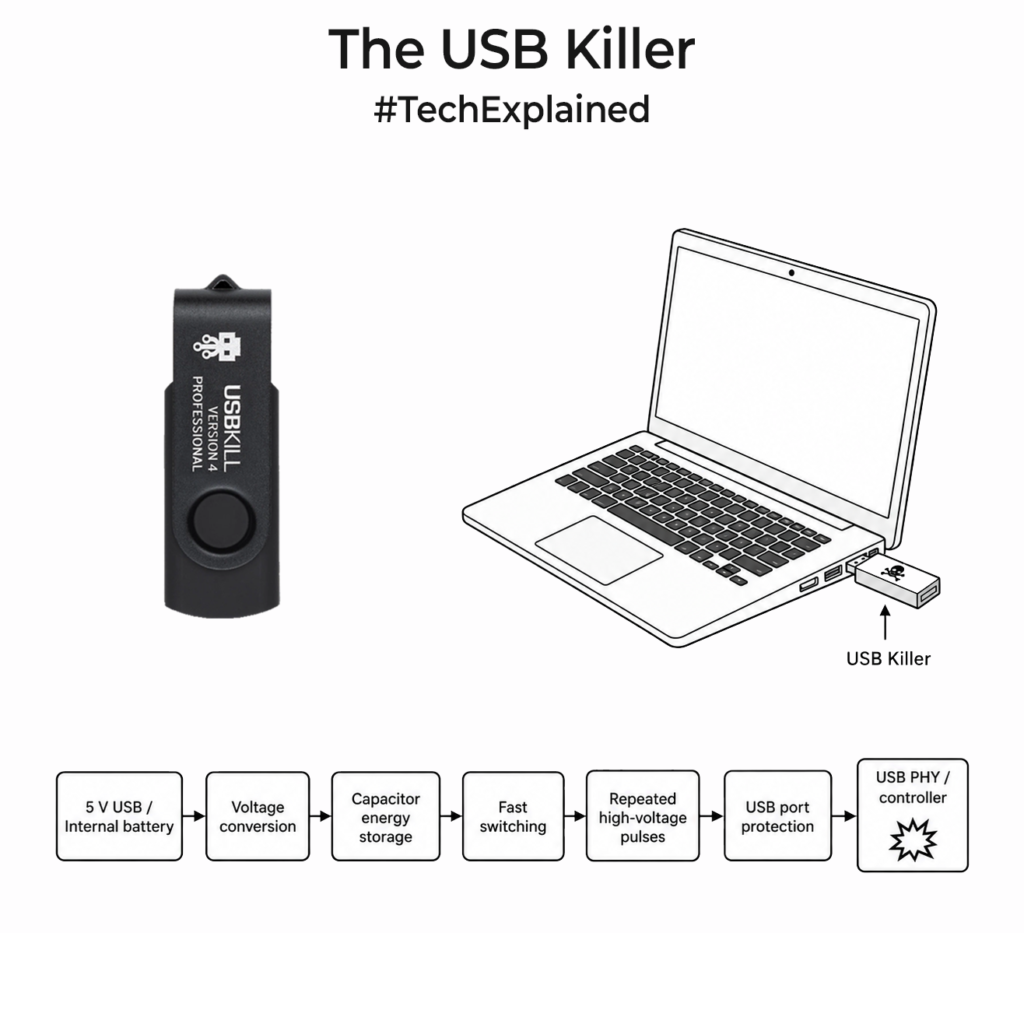
Fundamentally, the hardware has four blocks. It takes a low-voltage energy source, feeds a voltage-conversion stage, stores energy in capacitors, then switches that stored energy back into USB signal circuitry. Early designs charged the capacitors to around -110V, while later versions reached roughly -220V.
The interesting part is why normal USB current limiting on your host is not necessarily saving you. The host may limit how much current a device draws from 5V, but the device can accumulate that energy slowly and release it very quickly. Repeated pulses can over-stress ESD protection, damage the USB block in your PC, and potentially reach a hub, controller or SoC behind it.
USB-C made the original approach harder because a compliant Type-C source waits for a valid connection before enabling VBUS. Modern USBKill V4 versions can carry an internal battery, so they no longer need the target to supply that energy. Adapters also extend them to USB-C and other interfaces. Survival still depends on the host’s protection design.
Why does such hardware exist beyond malicious use as of today? Its role is destructive stress testing, helping hardware teams test whether ports survive abnormal electrical events and whether protection fails safely. It’s a tool that can be misused.
Your takeaway today should be to treat an unknown USB device as unknown hardware, not just unknown storage. A random device can severely damage a port or motherboard before software security gets any chance to react. You need to know that this exists.
0 Comments