I recently read about lithium-air batteries and got excited by their potential. Their theoretical energy density approaches petrol. Let’s discuss why.
Today’s commercial lithium-ion cells typically offer 160-300 Wh/kg. Specialized silicon-anode cells reach 450 Wh/kg. Petrol packs around 12,000 Wh/kg of chemical energy. Lithium-air offers 11,400 Wh/kg on a lithium-only theoretical basis, or about 3,500 Wh/kg including the oxygen consumed. Neither figure describes a finished rechargeable battery.
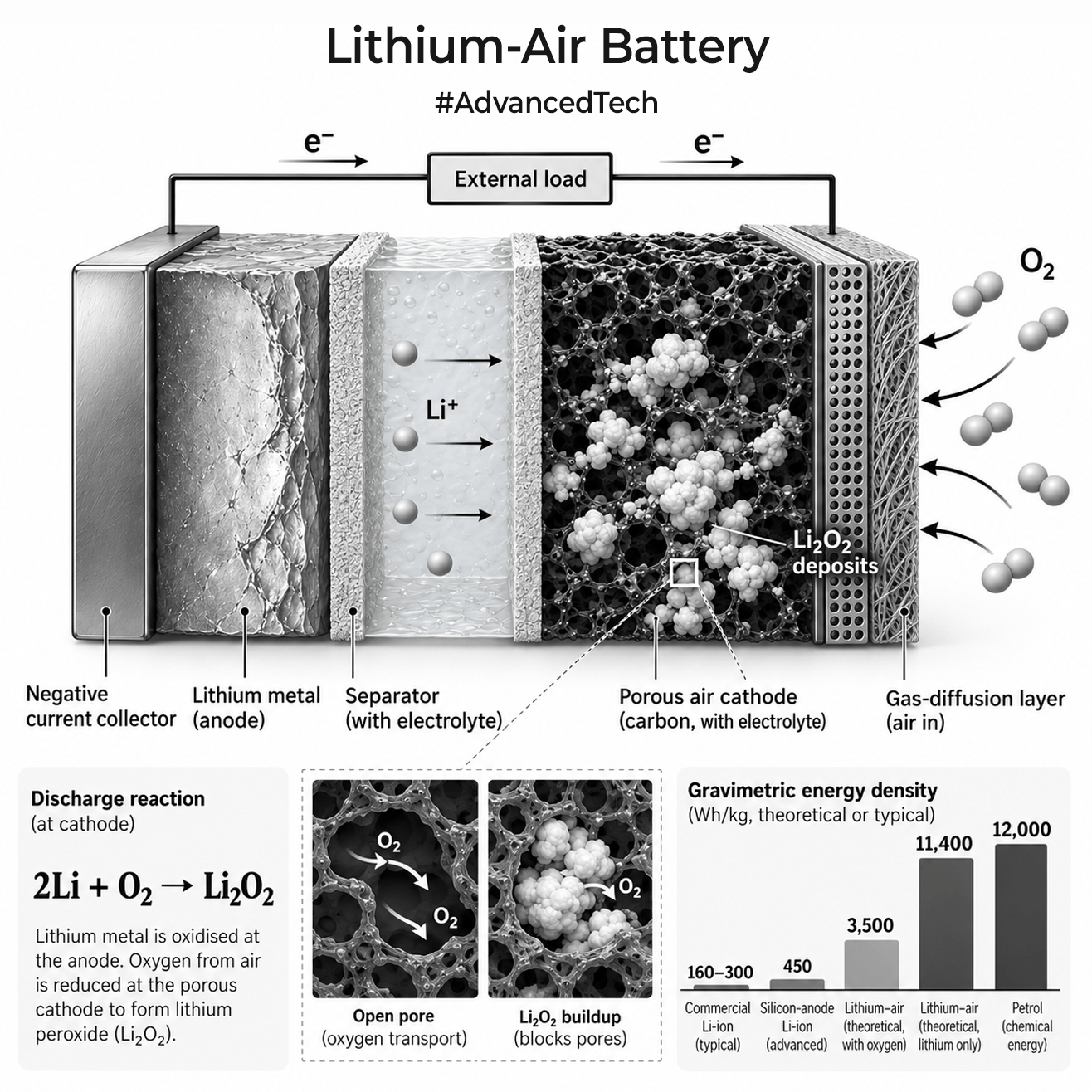
Lets talk chemistry. A lithium-air cell uses oxygen from outside. Lithium metal releases electrons into your circuit, while Li⁺ ions cross the electrolyte. At a porous cathode, oxygen, Li⁺ and electrons form lithium peroxide (Li₂O₂). Charging must reverse this reaction and release oxygen. It effectively breathes in like us.
Earlier this year, researchers in Japan demonstrated 740 Wh/kg from a 5.2 g experimental stack using dry air. Another study reported almost 799 Wh/kg in a prototype pouch cell. Separate limited-capacity cycling tests in the first study achieved around 68% round-trip energy efficiency and fewer than 100 cycles.
There are real hard problems in the tech though. Lithium peroxide clogs cathode pores and blocks oxygen. Moisture and CO₂ in normal air cause side reactions. Reactive oxygen damages the electrolyte, while lithium metal must endure repeated charging. Even lithium-ion cells age, need thermal control and risk lithium plating during rapid charging.
I think drones and aircraft may benefit first, because every kilogram matters. Cars will need more power, longer battery life and lower costs. Lithium-air is still at a very early stage, and there is a long way to go. But I believe we could one day build batteries that deliver as much usable energy per kilogram as petrol. That would be a huge step towards leaving petrol behind and moving to a world powered by renewable energy.
0 Comments