I was recently going through IEEE 802.11bf, the Wi-Fi sensing standard published last year. It kind of formalised procedures for Wi-Fi sensing. I think it’s worth diving into how it works.
So a Wi-Fi signal reaches the receiver through several paths. Some travel directly, while others reflect off walls, furniture and people. These copies combine at the receiver. When you move, the path lengths change, shifting their phase and amplitude. Wavelength is about 6 cm@5GHz. In an ideal out-and-back reflection, moving a person 1 cm towards the radio changes the path by 2 cm, producing a 120° phase shift. That measurably changes the received signal.
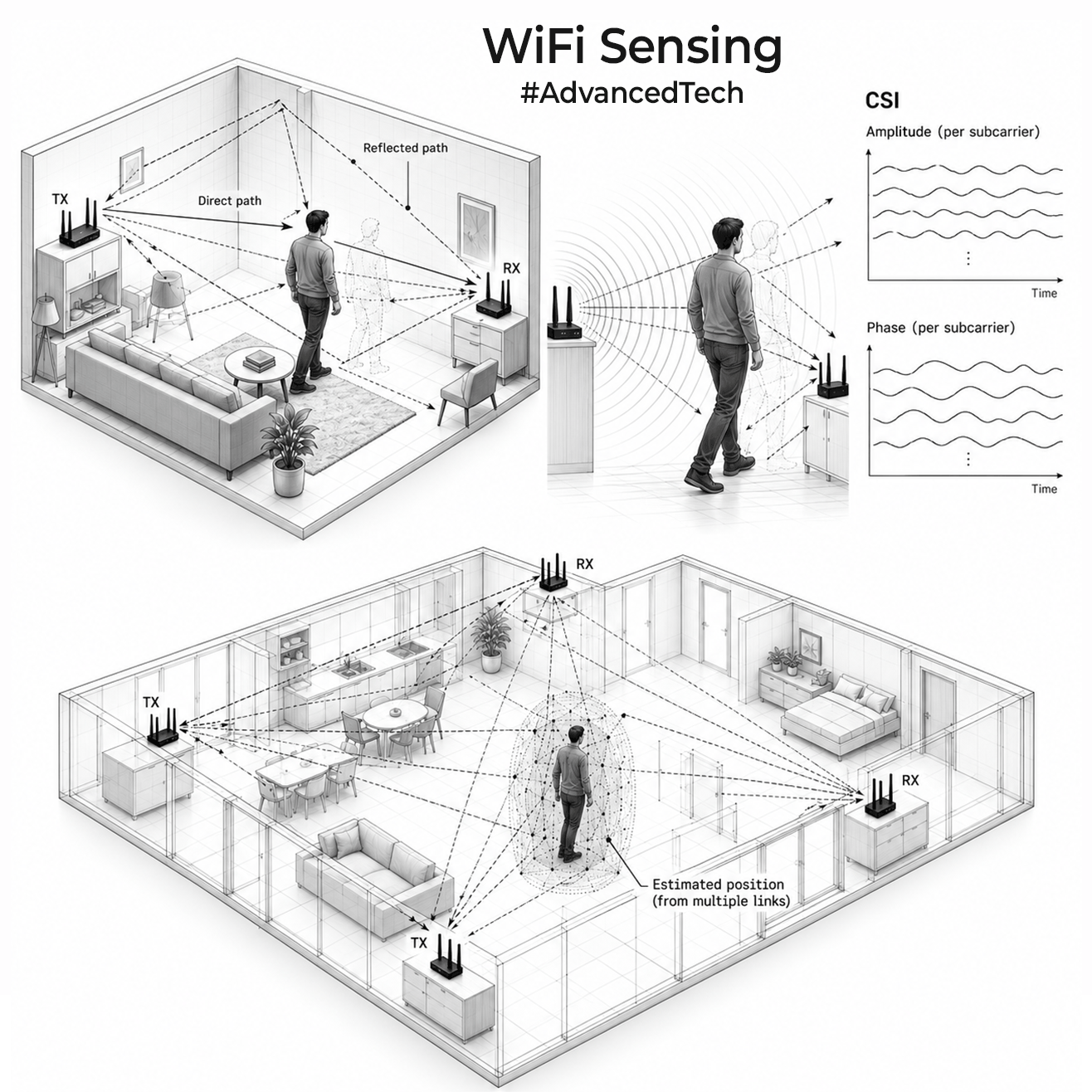
Wi-Fi receivers already estimate Channel State Information (CSI) to decode data. Wi-Fi splits a channel into many subcarriers. CSI estimates how each one’s amplitude and phase have changed during transmission. That gives much more detail than a signal-strength (RSSI) reading. By tracking CSI over time, software can detect motion and, under controlled conditions, infer gestures or even breathing. Unlike cameras, radio sensing may operate through walls, raising privacy concerns.
Now, can your home router reconstruct a 3D map of your room? In principle, you can estimate locations, but a typical router cannot produce a detailed 3D scan. You need multiple radio links or antennas, bandwidth and calibration. At 60 GHz, wider channels help resolve finer details, but blockage becomes an issue. Your router being Wi-Fi 6 or 7 alone doesn’t enable sensing. The chipset and firmware must expose useful channel measurements, with software to interpret them.
The company Plume already offers Wi-Fi motion alerts, and researchers have demonstrated 3D human pose tracking with multiple receivers. But movement from fans or pets can trigger false alarms. A person sitting still is much harder to detect than one walking. CSI reveals that something changed. Deciding what caused it remains the hard part. As sensing improves, maybe one day Wi-Fi could help automate lighting and alert caregivers to possible falls of elders without cameras. Future is great for this tech.
0 Comments