I was reading up for a client project on impedance measurements. While digging through, I ran into the auto-balancing bridge circuit used inside many LCR meters, and it’s worth understanding.
In the simplest form, impedance is just Z = V/I. You drive the DUT with a sine, measure the voltage across it, measure the current through it, and then divide. The problem is that an AC ammeter is never ideal. Its input impedance, wiring, and stray capacitance start affecting what you measure.
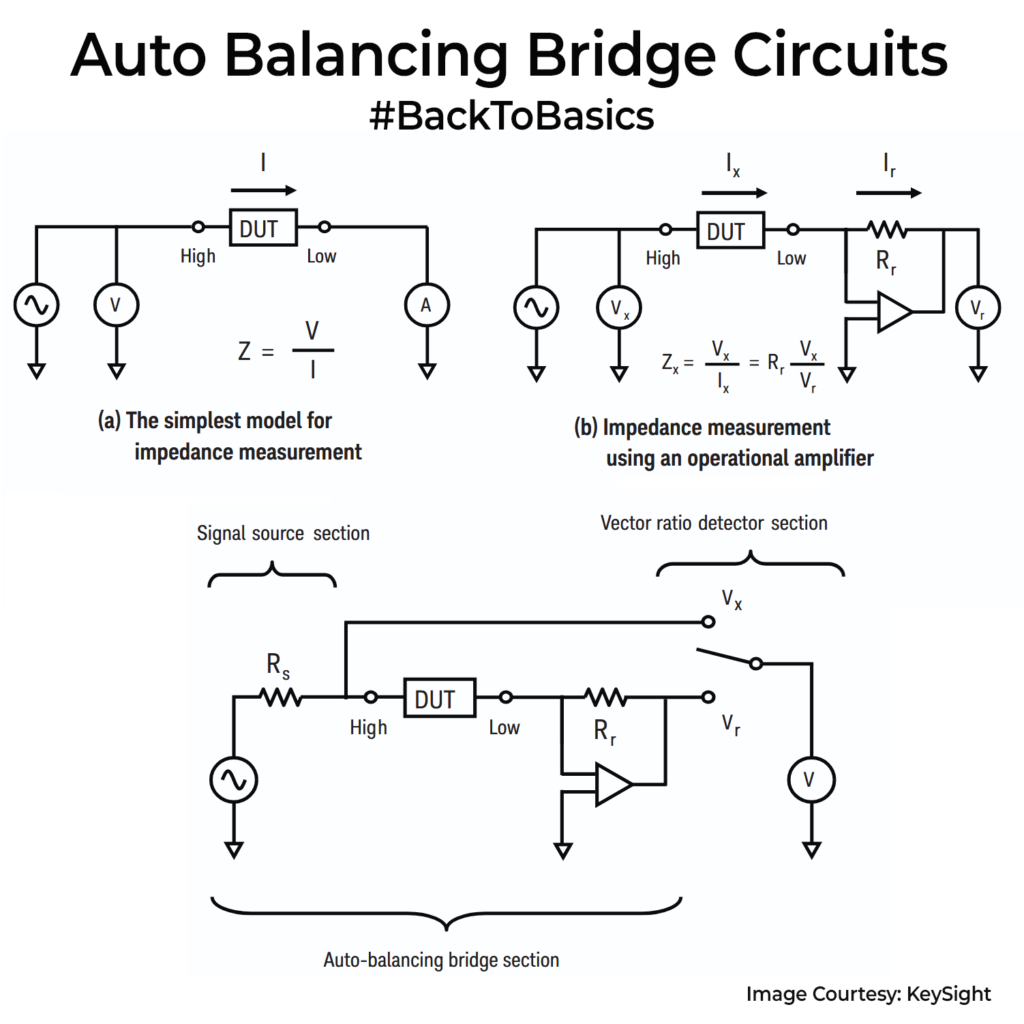
The auto-balancing bridge avoids measuring current directly. Check the images. Circuit forces the DUT current Ix to flow through a known range resistor Rr using a feedback amplifier. The Low terminal is driven to a virtual ground, close to 0V. Now the current becomes a voltage Vr across Rr, so Vr = Ix * Rr. You also measure Vx across the DUT. Put those together and you get Zx = Vx / Ix = Rr * (Vx / Vr). The instrument is really doing a vector ratio(Vx / Vr).
This setup would use two vector voltmeters, one for Vx and one for Vr, then take the ratio. The catch is there can be mismatch between meters. So many LCR meters instead switch one voltmeter receiver between Vx and Vr, so the same front end measures both and tracking error largely cancels.
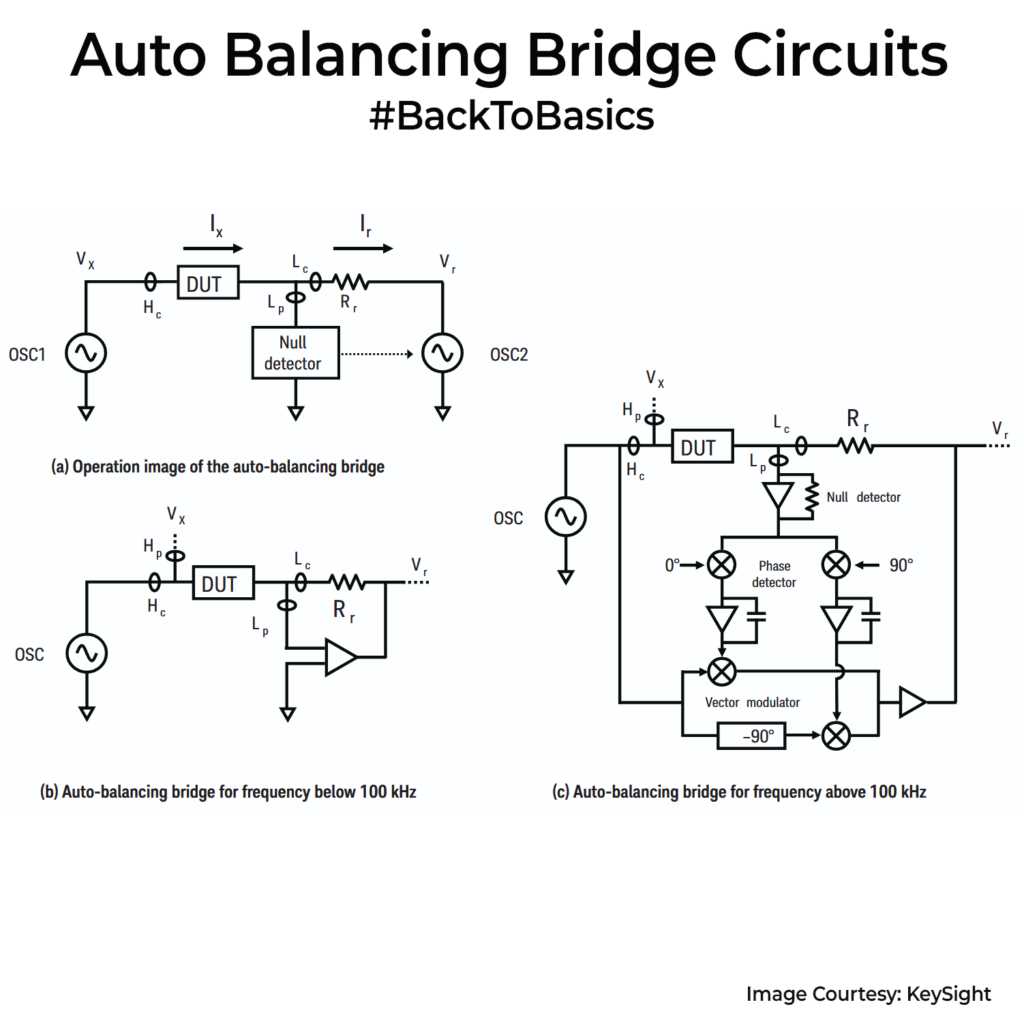
Below about 100 kHz, an op-amp transimpedance stage can hold the Low node near 0V and convert Ix into Vr. Above that, bandwidth limits and parasitics make the balance drift. So instruments add a null detector that senses leftover error current, split it into 0° and 90° parts, and drive a vector modulator to tweak amplitude and phase until the error goes to zero. That closed-loop correction is the auto in auto-balancing. BTW, its called auto-balancing because the instrument doesn’t rely on you to manually “balance a bridge” like old Wheatstone-style bridges. It uses a feedback loop that continuously drives the error toward zero on its own.
You use this circuit for getting your impedance U curves for capacitors, ferrite beads etc to a particular freq limit. For very high freqs (GHz), you often switch to network analysis/VNA methods.
0 Comments
Comments are closed.