I think the 4–20mA current loop is one of the simplest and most reliable ways to send analog sensor data over long distances. I’ll share a bit of history, why those spans exist, and some practical tips from my experience.
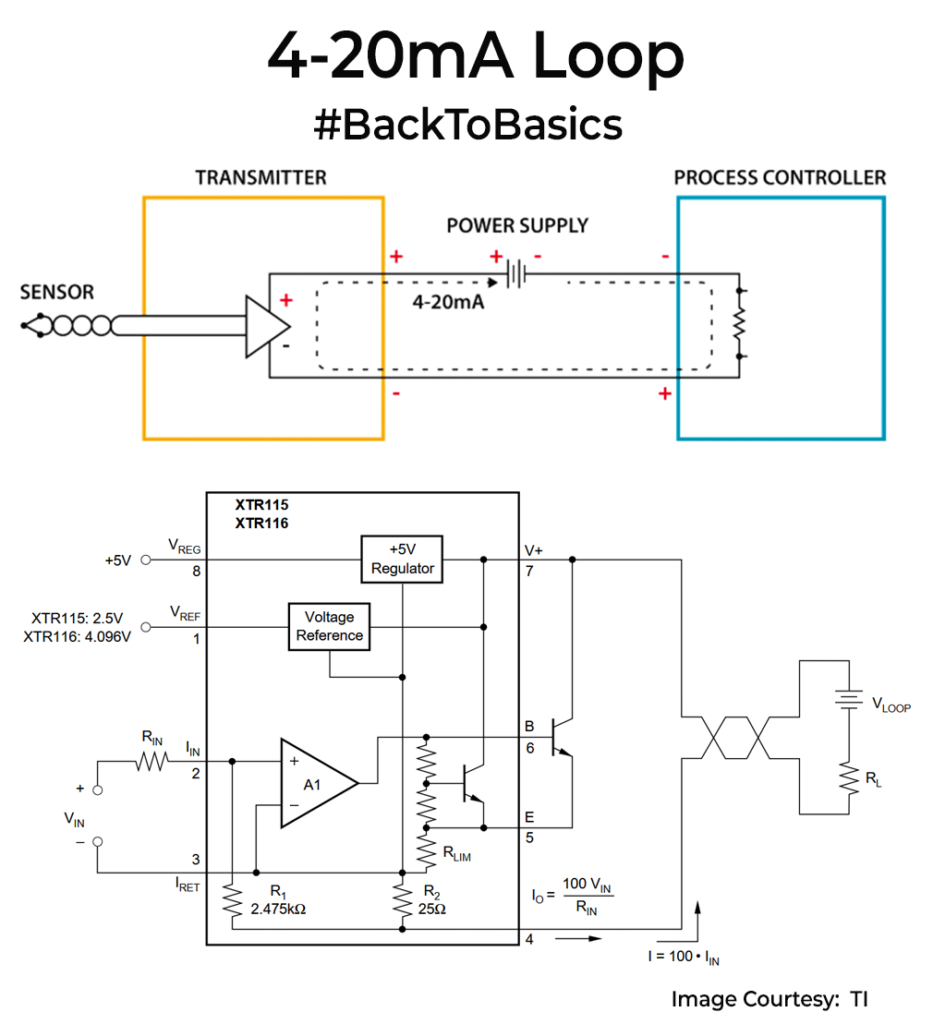
The 4–20mA loop dates back to 1950s process industries. The idea of a current loop really took hold when plants had to move from using pneumatic control (3–15 psi, purely mechanical) to electronic signals. Engineers needed a signal that could travel long over noisy wires without degrading. It was expensive to detect signals below 3psi hence the lower range of 3psi got stuck. By driving a constant current rather than a voltage, you avoid voltage‐drop issues in the field wiring: no matter what resistance the wires add, the receiver always sees the same current. BTW, lower limit is 4mA and not 0mA because of “live zero” measurement. It means if we use 0mA we can’t detect if the value is actually meant to zero or the loop is broken because of power loss or wire-break in circuit.
Technically, a 4–20mA loop is just that: the sensor or transmitter adjusts its internal resistance so that it draws between 4mA (minimum) and 20mA (maximum) from a fixed 24V DC supply. The controller reads that current across a shunt resistor (commonly 250Ω, so 4mA→1V, 20mA→5V) into an ADC(If its Vref is in that range). Why 20mA at the top end? It’s a practical limit. Early transistors and relays tolerated up to around 20mA without burning out or dropping too much voltage.
In practice, you’ll see 4–20mA used for pressure transducers, temperature transmitters, flow meters, level sensors, pH probes, and almost any industrial instrument. When practically implementing circuits for 4-20mA, make sure to take care of ground loops and to have isolation circuit in the front end of your receiver, purely as you are working in industrial environments. There are a lot of ready-made ICs from major suppliers to help build the 4-20mA loops. Search online and pick from them.
Fun fact: you can layer HART digital communication onto a 4–20mA loop without disrupting the analog measurement, allowing for diagnostics.