Tech Explained: Neutron Imaging

I was exploring tech for some non-destructive testing and came across Neutron Imaging. Felt it was interesting enough to discuss on a post.
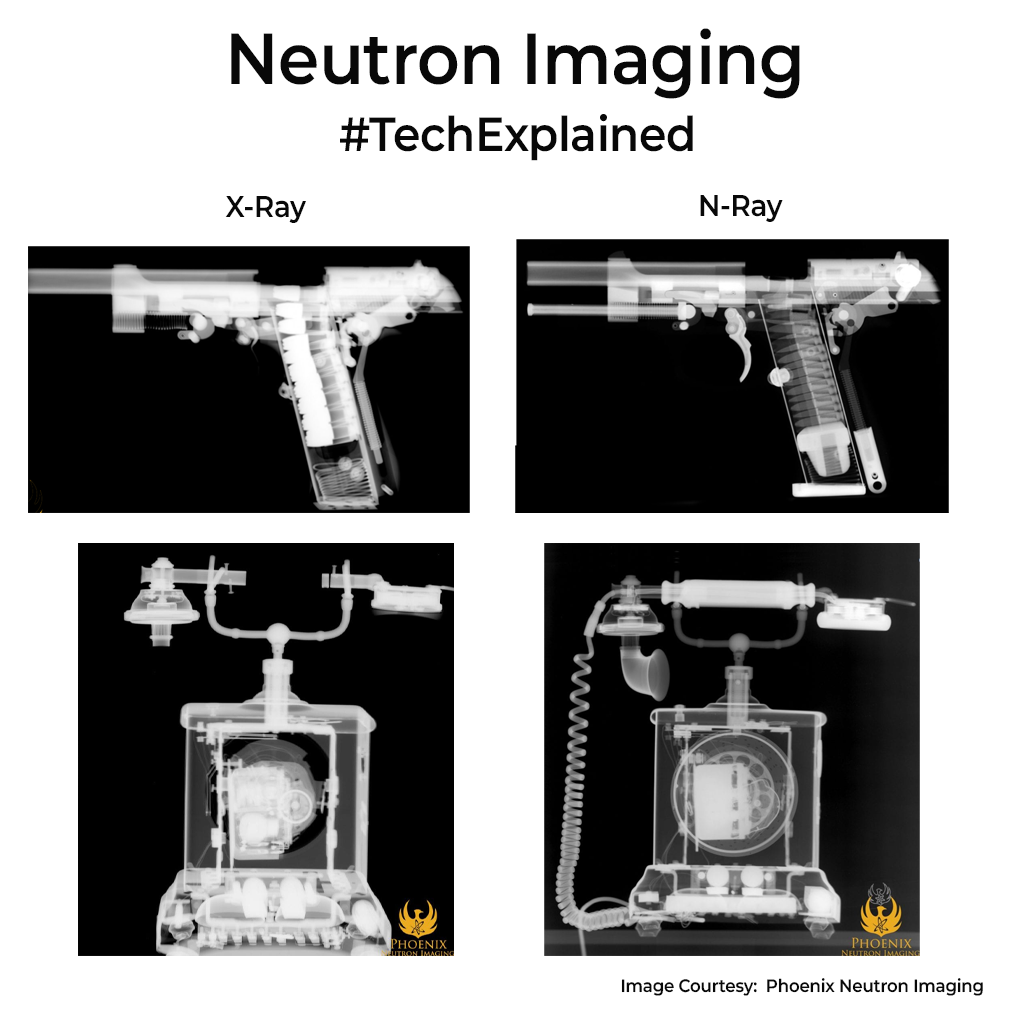
Neutron imaging uses neutrons to probe inside objects by interacting with atomic nuclei, so it reveals light elements (hydrogen, lithium, boron) hidden in heavy metals. The tech dates back to the 1940s, when early work produced the first radiographs of mechanical parts.
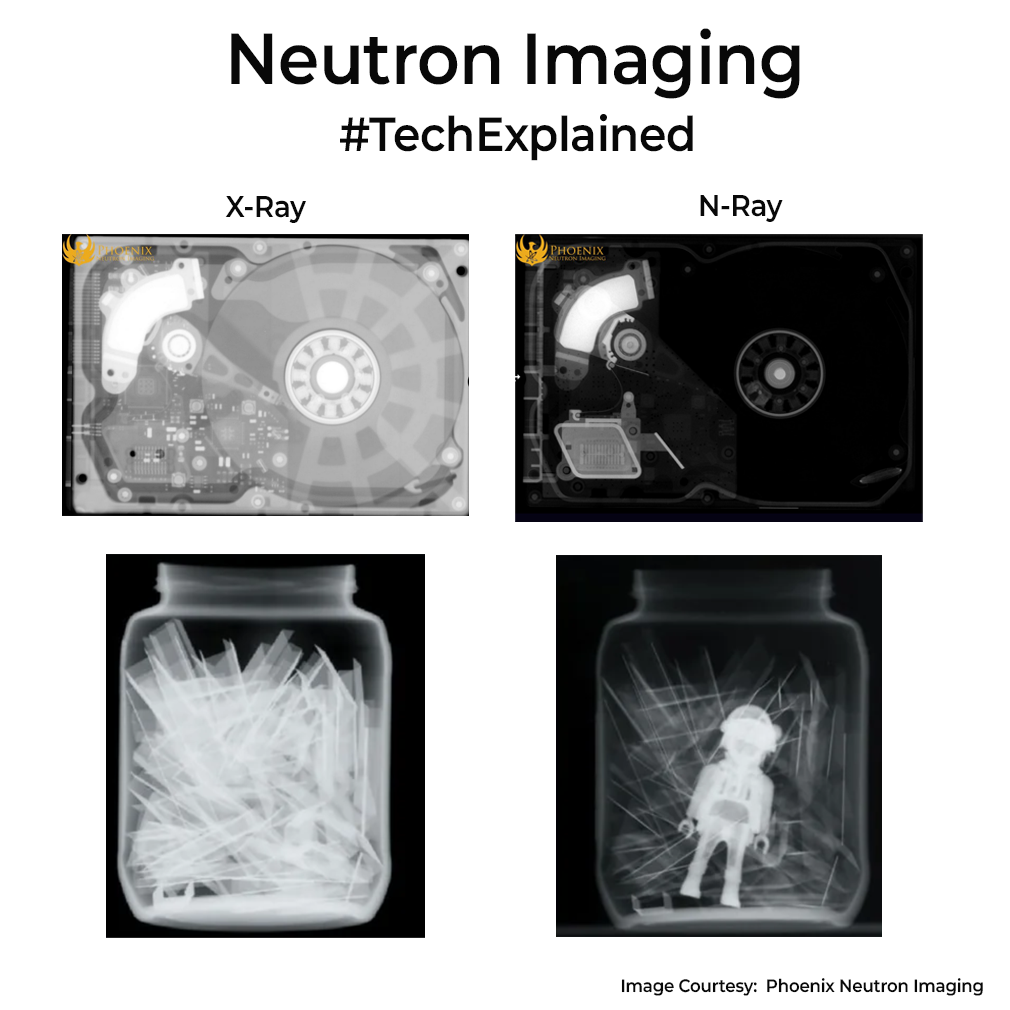
In a typical setup, reactors or accelerators generate neutrons, moderators slow them, and collimators shape a focused beam. As neutrons pass through a sample, materials attenuate them differently. A scintillator converts transmitted neutrons into light, which is recorded by a camera for 2D images.

The science behind it is all about contrast mechanisms and energy dependence. Materials rich in hydrogen show up dark, while dense metals can be almost transparent. Thermal and cold neutrons (at energies around 0.025 eV or lower) give high spatial resolution, whereas fast neutrons (in the MeV range) penetrate thicker samples but sacrifice some contrast. By rotating the object and collecting many 2D images, you can reconstruct a 3D map of internal features, much like a CT scan.

Compared to X-rays, which excel at imaging heavy elements and bone due to interactions with electrons, neutron imaging complements them by highlighting light, often organic, materials inside metal casings. So both these techs are complimentary. Check the images for differences.

It has applications in visualization of internal components in automotive and aerospace industries to detect defects, and assesses hydrogen distribution in fuel cells as well as lithium concentration, Li-metal anode structures, and electrolyte dispersion in Li-ion batteries. I do think they have a use case in airport baggage screening machines to see what X-ray/CT machines fail to capture. But might be too bulky/expensive for routine checks.

PS: Neutron imaging can even map water intake inside a plant root, something X-rays simply can’t capture.
If you liked the post, Share it with your friends!

Back To Basics: SFP

I was planning to do some home networking and happened to run across SFPs. Let’s see those in detail today. SFP stands for Small Form-factor Pluggable, and it’s essentially a hot-swappable transceiver module that plugs into a switch or router port to adapt to different media types.

SFP connector

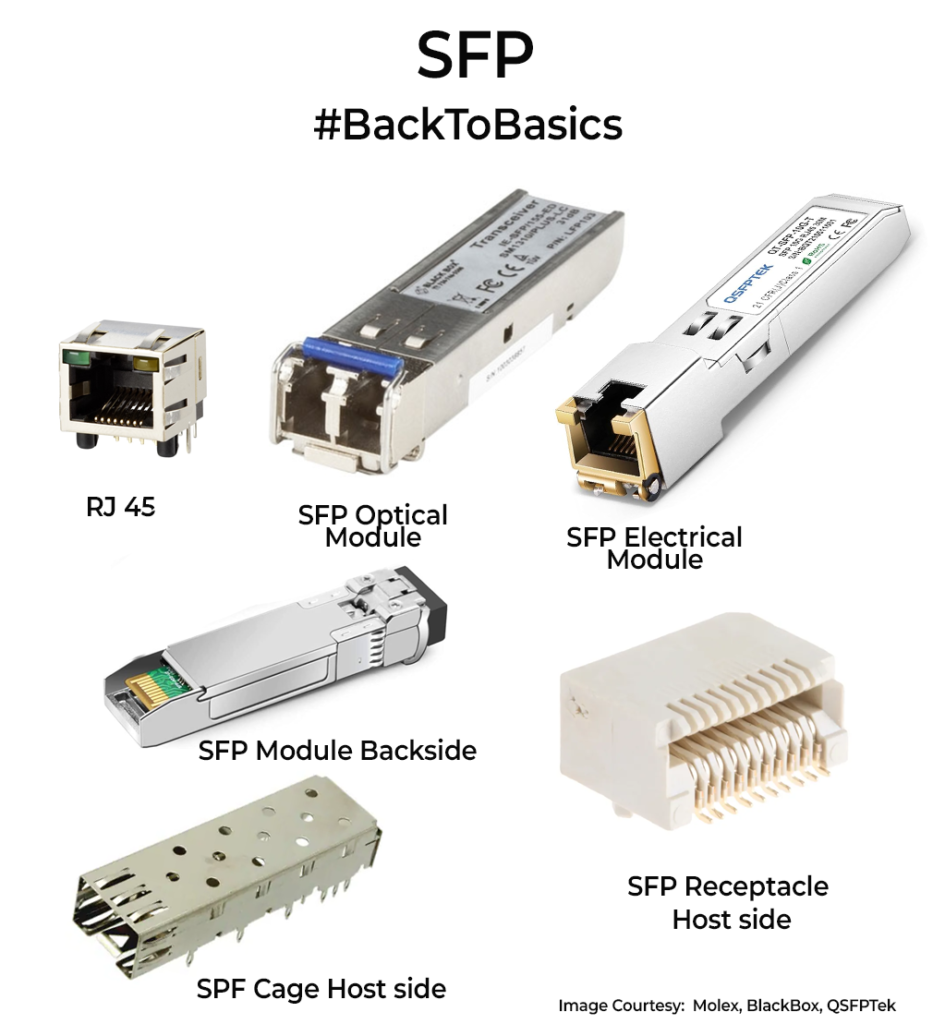
All of would know the classic RJ45 connectors, that can be used for connecting Copper cables(Cat5e) to network interfaces. As networks grew beyond 100m and speeds pushed past 1 Gbps, a better interface became necessary. Around the early 2000s, major vendors agreed on the SFP, so different manufacturers could supply compatible modules. In SFPs, you get a slot where you can choose a copper module for short runs or an optical fiber module for longer distances, even mixing multimode and single-mode fibers. That was a game-changer for cost and flexibility. SFP is a port that eases the life a bit for the designer, as they really don’t need to take care (to an extent) if it’s Copper or Optical cable on the end. No board respin needed.

Physically, the SFP “cage” connector is larger than RJ45. The SFP module fits inside the connector and has the interfacing circuitry required, freeing the host board from that footprint. It’s hot-swappable, meaning if a copper port fails, you replace just the module without powering down the device.

In practice, you will use for a copper SFP module when I need to extend a cable-run just beyond the 100 meter RJ-45 limit. For anything over a few hundred meters, or if you need immunity from electrical interference, fiber SFP (or SFP+) is the answer.

SFPs come in different types considering the speed class they cater to you. Look up on wiki for the full list. There are variations like QSFP (Quad SFP) and QSFP28, catering to 100 Gigabits of transfer speed. These are the things that move data around in data centres. In essence, SFP allows for a host of things as a pluggable interface.

If you liked the post, Share it with your friends!
1 14 15 16 17 18 99