Tech Explained: Taalas AI Inference Chip

A couple of days back I heard about an interesting new startup called Taalas, and they are doing some interesting work in the LLM inference space. I thought we’ll try to deep dive on what I found about that today.

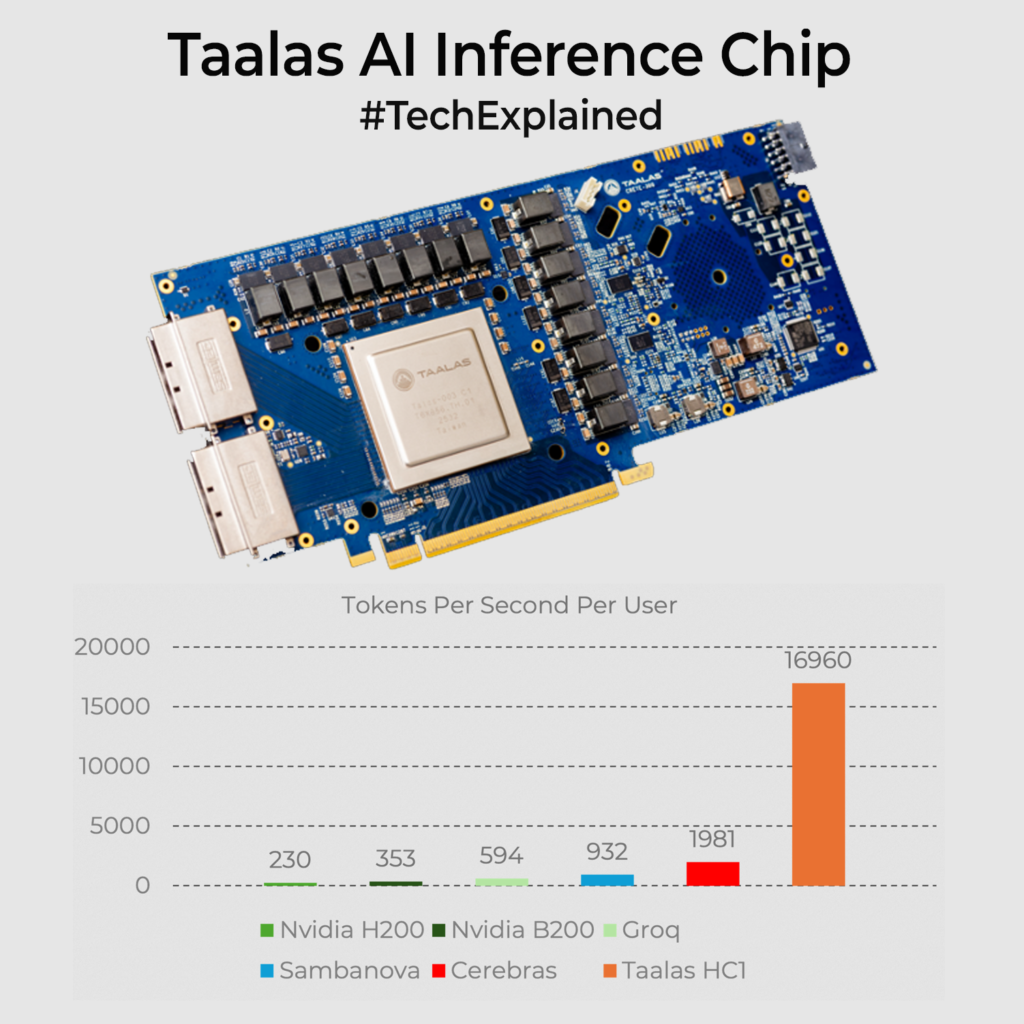
They take a trained model like Llama 3.1 8B and turn it into a fixed chip. Instead of a GPU pulling weights from High Bandwidth Memory(HBM) every token, the weights are baked into silicon in a big ROM like fabric. The model and the hardware are basically the same thing, so you are really buying a specific model in PCIe card form.

On their first part, HC1, they talk about roughly 17k tokens per second per user for that 8B model at around 200W power. The nearest competitor is the Cerebras chip which does around 2k tokens per sec. With every weight on the die and no HBM in the loop, most of the work becomes local switching instead of moving GBs back and forth. To visualize it, think of a grid where each weight is a tiny logic cell, not a number in memory. When an activation vector arrives, that grid lights up along fixed paths and each cell contributes its small multiply and add. The layer output appears with almost no indexing overhead. SRAM around it holds KV cache and adapters, so you can still add LoRA style tweaks. Try out at chatjimmy.ai It’s mind-blowingly fast, the moment you hit the Enter key.

Where could that be useful? Anywhere you are happy to standardise on a stable model and really care about latency and cost per query. Meaning robots, edge devices, superfast agentic frameworks etc.

Am I really convinced if this is the way ahead? I am not sure. Since it’s baked into the Silicon, you loose flexibility when you want to change things. You need big deployment volumes to make the economics work. By the time a tape out happens(they say 60days), the next generation model would be out there. Also not sure how it scales for large Trillion+ token models. A classic case is for stable popular older models like ChatGPT 4o if its weights are open sourced, its fanboys would love to bake it with Taalas and use for deployment since OpenAI sunsetted the model last week. There is potential lets see where this goes.

If you liked the post, Share it with your friends!

Tech Explained: WiFi 6GHz Band

Small good news for wireless in India this week. The government has finally delicensed part of the 6 GHz band for Wi-Fi at home. I see a new rule came about this week to open up 5925-6425MHz for low power indoor and very low power outdoor devices on a licence free, shared basis. This means routers and clients that support 6 GHz can now legally use it in India alongwith 2.4 GHz and 5 GHz.

6GHz gives Wi-Fi 6E/7 a lot more clean spectrum than 5 GHz. We have 500MHz Bandwidth free because of the de-licensing. That is still big enough for three 160 MHz channels (3×160 = 480 MHz, plus guard) or one 320 MHz channel with some spectrum left. Wider channels means faster traffic. That lets a good router plus a 6GHz phone or laptop move traffic faster with less interference when both ends support it. Notification says low power indoor access points can radiate up to 30 dBm(1W) Radiated Power, while very low power outdoor devices are capped to 14 dBm. Emissions outside 5925-6425MHz must sit below −27dBm/MHz, so there cannot be any power leakage into neighbouring bands. Equipment also needs integrated antennas and Indian type approval, so no giant external 6GHz sticks.

All of this means if you have a home server and connected devices like NAS or TVs, you can now get superfast speeds. But Physics still applies here. Compared to 5GHz, you see approx 1-2 dB extra loss through a wall for 6GHz, which means about 10-20% less usable range. Meaning, ideally you might want to have direct Line of light or an access point in the same room for full speed benefits. If you have those high-end routers I would configure all the high bandwidth devices dedicated on this 6GHz channel and others on a separate longer range 2.4GHz channel.

Many recent phones, laptops and routers already ship with 6 GHz capable radios, but had the band disabled in India. Most likely you will see firmware updates from these vendors to enable the 6GHz bands in India, though some gear will probably never be updated. So be on the lookout.

If you liked the post, Share it with your friends!
1 6 7 8 9 10 23