I was looking for a long-term rechargeable option for a few household gadgets. I knew 1.5 V lithium AA cells existed, but I had never used them till now. So I thought today was a good day to explain how they work.
Lithium batteries in consideration are of two kinds. The first is primary lithium AA, using lithium–iron disulfide, or Li/FeS₂. It is non-rechargeable and naturally delivers an alkaline-compatible 1.5V. These cells are light, handle high loads and cold weather well, rarely leak, and branded versions can have a shelf life of around 25 years. They are roughly ₹200-₹300 per cell in India, they suit outdoor sensors and “put-and-forget” devices.
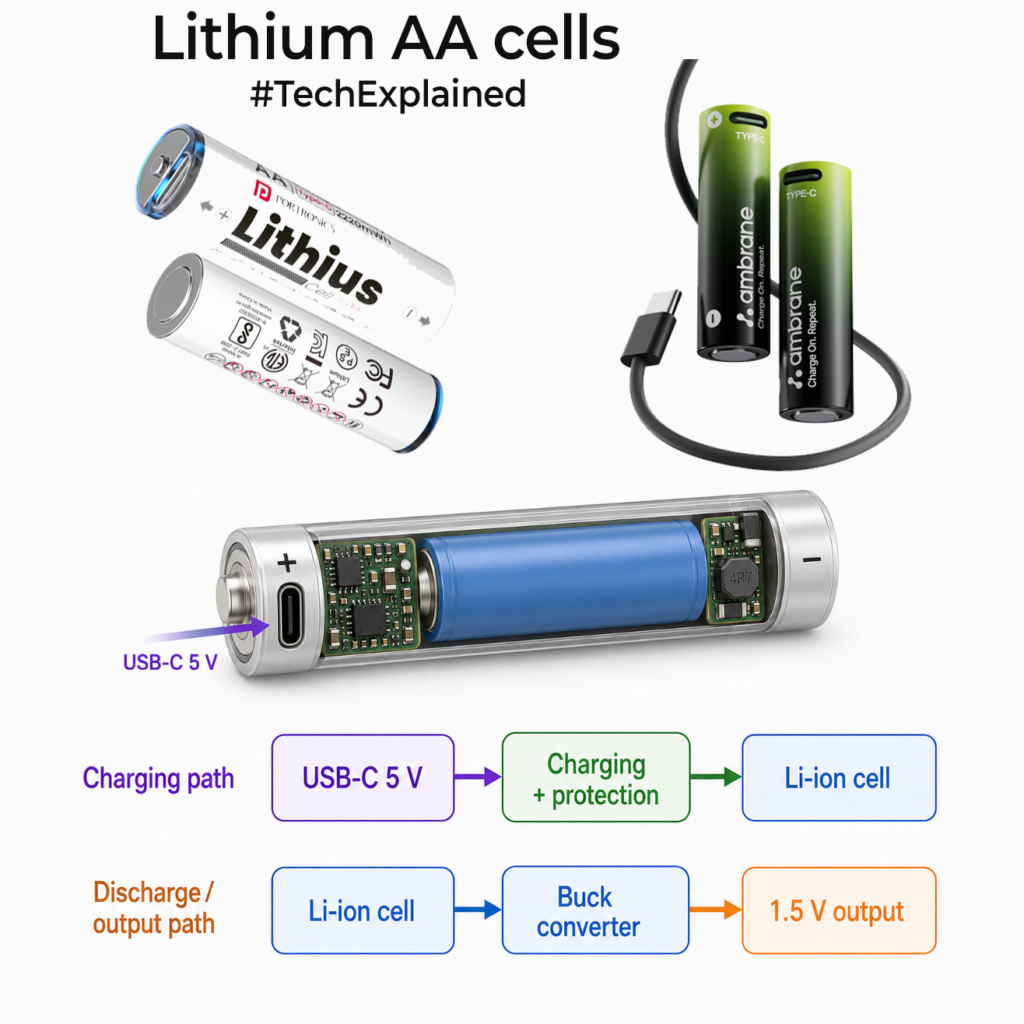
The second kind fits a rechargeable lithium system inside an AA shell. It usually contains a 3.7V lithium-ion cell, a protection circuit, and a buck converter that steps the output down to a steady 1.5V. USB-C versions also contain their own charging circuit. The 5V input charges the internal cell, while the buck converter powers the gadget. So every battery is has a tiny charger, protection system, and regulated power supply.
They can do approx 1,000-1,200 recharge cycles. Real life as always depends on temperature, discharge depth, charging quality, and how long the cell stays fully charged. Four-cell packs in India cost around ₹1,200-₹2,000. A good thing about them is they always provide a steady 1.5V compared to alkaline ones that start at 1.5V and drop to around 1V when dead. Lithium versions are also lighter and often provide more usable energy.
There are trade-offs. The converter adds standby drain, switching noise, and a current limit. That makes these cells less suitable for wall clocks, low-power remotes, and sensitive audio equipment. In the end, the choice depends on the device and how you use it, rather than one chemistry being universally better. Please know that Lithium ones are a valid option for your future needs if you want to spend more.
0 Comments
Comments are closed.