I recently came across the topic of ambient backscatter and found the circuit idea ridiculously simple. You normally transmit data by generating and modulating an RF signal. Now what if you could send the same few bits by changing a radio wave that is already around you? Let’s discuss that.
To explain this, Imagine a small temperature sensor tag near a Wi-Fi access point. It has an antenna, a transistor acting as an RF switch, and basic control logic. A receiver sits elsewhere in the room. The Wi-Fi access point provides the incoming radio waves, so the sensor does not have to produce a carrier itself.
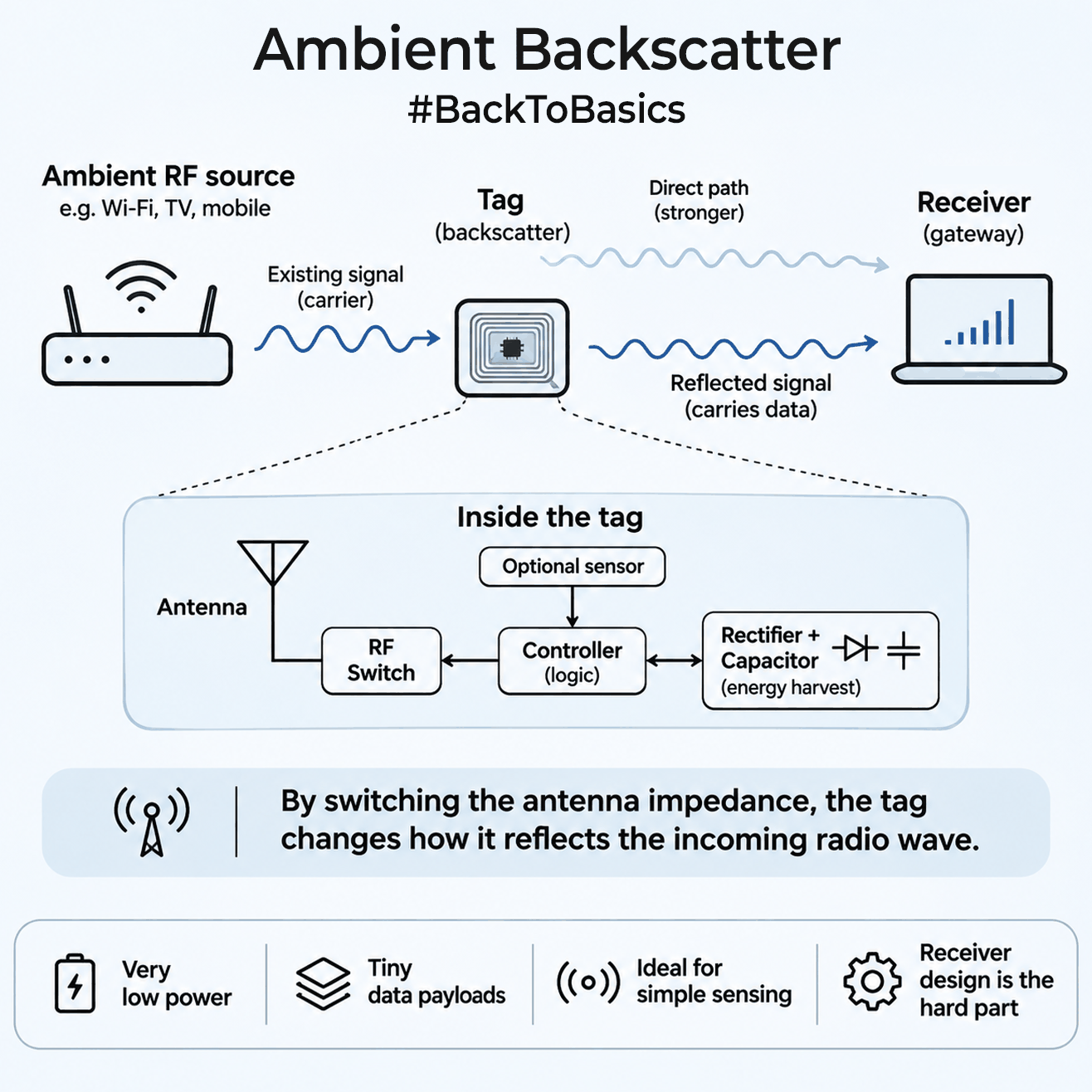
Now onto the physics side of it. A radio wave induces current in the tag’s antenna. Its impedance, the electrical load attached to the antenna, changes the current and the wave it reradiates. Switch the impedance between two states, and the amplitude or phase of the reradiated signal changes. Drive that switch with the bits of a temperature reading and the reflected wave now contains data.
At the receiver, the original Wi-Fi transmission is much stronger than the tiny reflected component. The reflected wave travels along two legs, from access point to tag and then tag to receiver. Recovering the bits therefore needs a compatible receiver and careful signal processing. An ordinary Wi-Fi device cannot automatically read it.
There is a second problem. The RF switch consumes very little power, but the sensor and controller still need energy. Some designs rectify part of the incoming RF into DC and charge a capacitor. That can remove the battery, but the usable energy is tiny. Distance, antenna orientation and how often the access point transmits all matter.
This principle is familiar from passive RFID, where a reader supplies the RF signal on purpose. Ambient backscatter uses existing transmissions instead. I think its most interesting role is in simple asset or environmental tags that send a few bytes occasionally, rather than devices streaming continuously.
0 Comments