These days key fobs that unlock a car while still in your pocket are fairly common. The car is doing more than checking whether a valid key is nearby. It needs to work out whether that key is outside, near a particular door, or already inside the cabin. Let’s focus on that bit of tech today.
Usual car passive-entry system uses two wireless links. The car has several low-frequency antennas (~125 kHz) placed around the cabin and different parts of exteriors. When you touch a door handle or another wake-up condition is triggered, it energises one or more antennas and sends a wake-up message and cryptographic challenge.
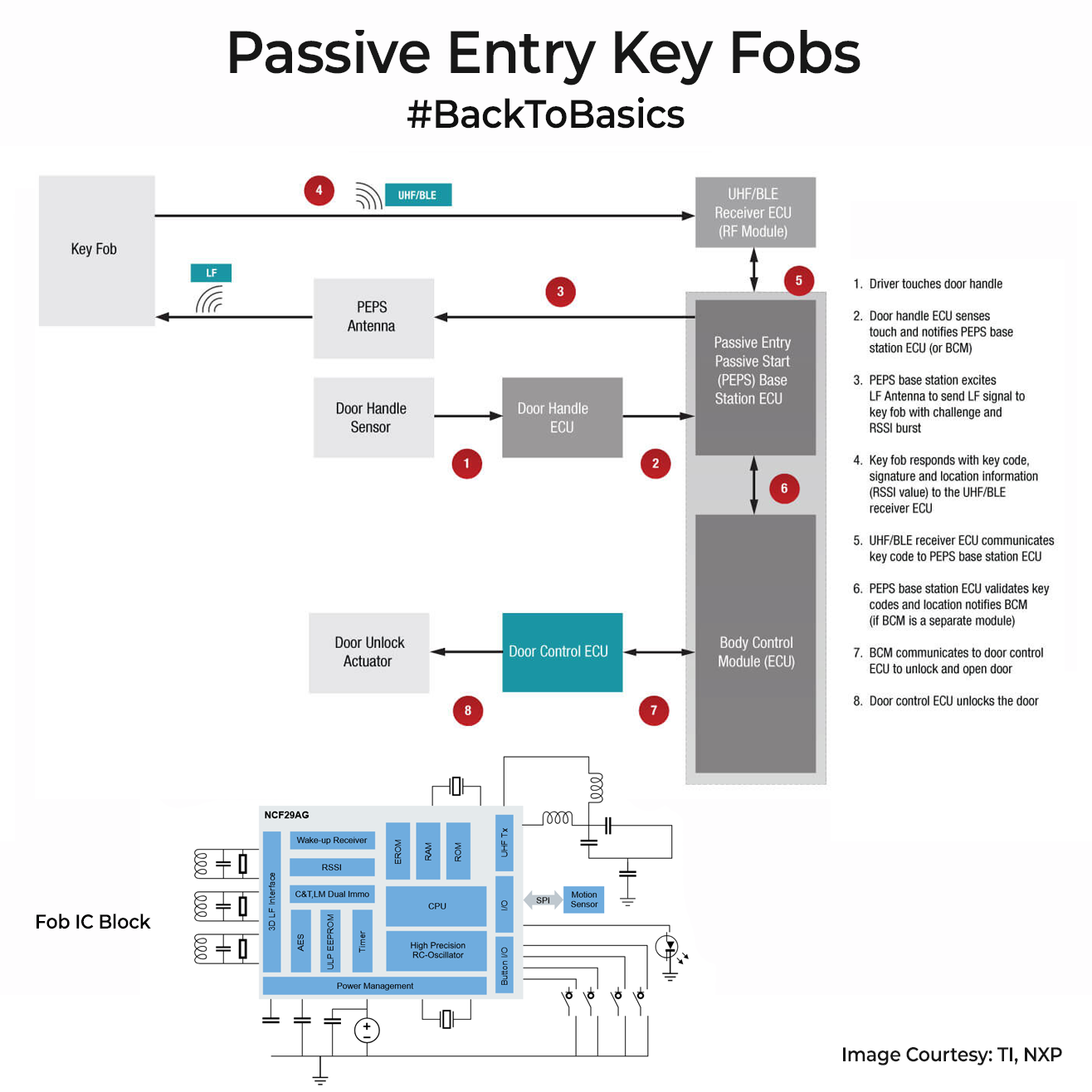
Now, inside the fob is a low-frequency receiver, often using three orthogonal coils so it can receive the magnetic field regardless of how the key is sitting in your pocket. The fob measures the field strength, processes the challenge, and sends an authenticated response back over a longer-range UHF or sub-GHz radio.
So the question now is why several antennas? One measurement gives only limited position information. Comparing field-strength readings from different locations lets the car classify useful zones such as driver-door side, passenger side, boot area or inside the cabin. It usually does not need an exact x-y coordinate but needs enough confidence to decide what action is safe.
That is what separates passive entry from the older remote-keyless-entry fob. With the older system, you press a button and the fob transmits an authenticated command. Passive entry adds a car-to-fob wake-up path and proximity information, so the key can stay in your pocket.
Newer systems can replace this approach with Bluetooth Low Energy and UWB. BLE handles low-power communication, while UWB can measure distance much more precisely using signal timing. The underlying question remains the same: is this an authorised key? and is it physically where the car expects it to be? You just use better tech to answer that these days. That’s it.
0 Comments