Back to Basics: 3 Terminal Capacitors – Part 1

Many of you might not have heard or used this one. Let’s see what the heck these are today.

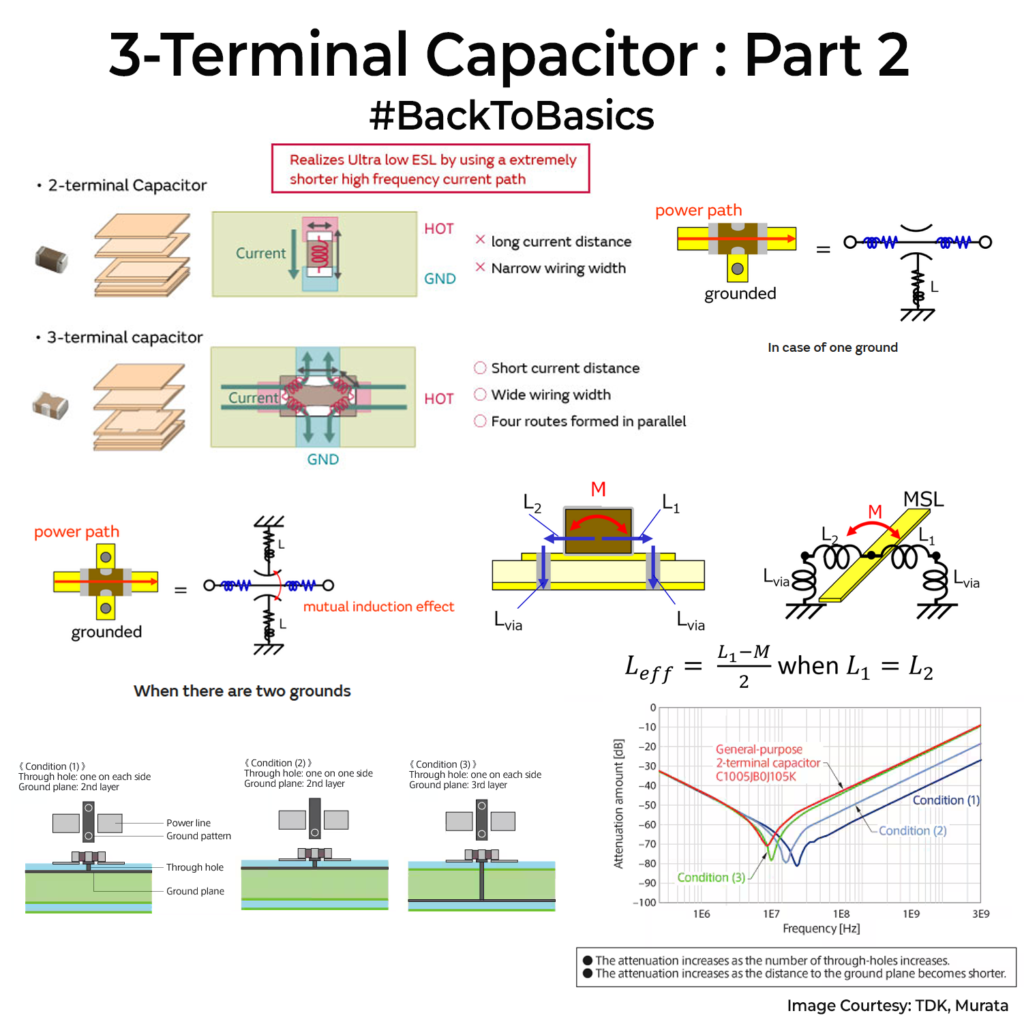
3-Terminal Capacitors (Technically it’s a 4 terminal one.) is an MLCC whose internal electrodes are arranged as a feedthrough 2-port. Your signal enters on one end, exits on the other, and the third terminal is a ground plate. In many packages, ground is split into two pads, so you see 4 pads, but both ground pads are the same node.

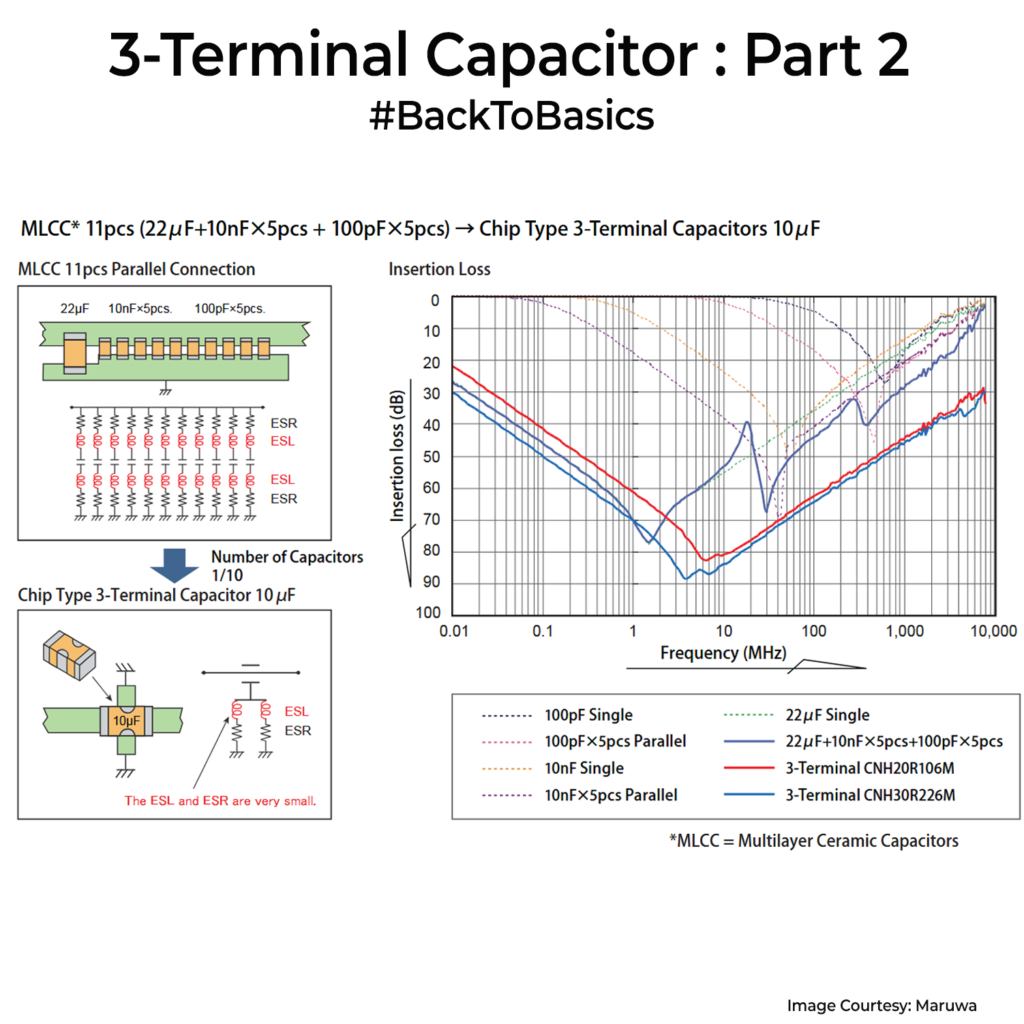
Why do this then? In a normal 2-terminal decoupling cap connected to ground, the high-frequency current has to go through pads, vias, and plane. That loop inductance(ESL) is often a limiting factor. A 3-terminal part forces the line to pass through the component while giving the noise a short, symmetric path to ground. That reduces effective ESL. If you look at the attenuation curves, the difference is very clear. A 3-terminal part keeps behaving like a real capacitor much higher in frequency because its effective ESL is far lower. You can try to approximate it by placing two normal capacitors in parallel, but that rarely fixes the core problem, which is the loop inductance. In practice, one 3-terminal capacitor can deliver the same high-frequency suppression you’d otherwise get with several 2-terminal caps in parallel.

A 3-terminal capacitor is useful when you need better noise filtering at high frequencies, not just more capacitance. It works well at boundaries, like where a buck regulator feeds an RF module, a camera or sensor section, or where power enters a shield can or connector. The big advantage is that it can reduce high-frequency noise with fewer parts and more predictable results. The downsides are higher cost, limited values and current ratings, and it only works well if you place it correctly with a very solid ground connection.

There’s a lot more to using these in real circuits, including placement, grounding, and how to choose the right part etc. I can’t fit all of that here due to the post character limit. If there’s genuine interest, I’ll do a follow-up post.

If you liked the post, Share it with your friends!

Back to Basics: Ferrite Beads

Easily one of the most misunderstood parts out there. Folks use them as a magic dust to sprinkle it here and there in the circuit without really understanding its use case. These are very specific, frequency-dependent resistors that you place on purpose, and only after you know what noise you are after. Let’s discuss this today.

A ferrite bead is a small piece of ferrite ceramic with a conductor through it. In most SMD beads, it’s built as multiple layers of ferrite with metal electrodes, arranged, so the current still passes through ferrite material along its path.

At DC and low frequency, it looks almost like a short (10-300 mΩ range). As frequency rises, its impedance rises first because of inductance. Then the ferrite losses kick in, and the impedance becomes mostly real resistance, so RF energy turns into heat. At still higher frequency, the parasitic capacitance dominates, and the impedance  falls again. That is why you see datasheet impedance curve has a hump.

You use beads when you want to block high-frequency noise without isolating DC. Common cases are splitting a noisy digital 3.3V rail from a quieter analog 3.3V rail, feeding an RF block, cleaning up sensor power, or removing EMI on a cable line together with a shunt capacitor(Check older posts for more details on this).

A ferrite bead datasheet usually starts with a headline like “600Ω @ 100MHz”. That number is the bead’s impedance measured at one test frequency, and the graph beside it shows the full impedance vs frequency curve. Use that curve to match your noise band. If your noise issue is at 10MHz or 500MHz, adding this ferrite bead is useless. To find your noise band, use a near-field probe or spectrum analyser to see the spikes.

Also watch the DC bias. A 1A load can push the ferrite toward saturation and cut the impedance drastically. Also ensure that the ferrite bead can handle the heat when a large current passes through it. It will cause a voltage drop in the rail too. Most people forget to size the bead it correctly for power.

If you liked the post, Share it with your friends!
1 2 3 4 5 6 73