Advanced Tech: Image SynthID Reversal

Last week we discussed SynthID and how it watermarks AI-generated content so specific detectors can identify it. Today I wanted to discuss a GitHub project by aloshdenny that claims to confuse Gemini’s SynthID image detector. I think its an interesting piece of akin to cracking software security by reverse engineering. Lets discuss how something like this can be done.

SynthID has an invisible image watermark that’s fundamentally a weak signal hidden inside pixels. In a normal mountain or portrait image, that signal is buried under texture, edges and color variation. So the method’s first move is to simplify the input. It uses plain Gemini images, like near-white or near-black frames. When the image content is almost flat, repeated hidden structure becomes easier to isolate by enhancing contrast and saturation. You can then amplify the residual, which means studying tiny pixel variation that should ideally stay invisible.
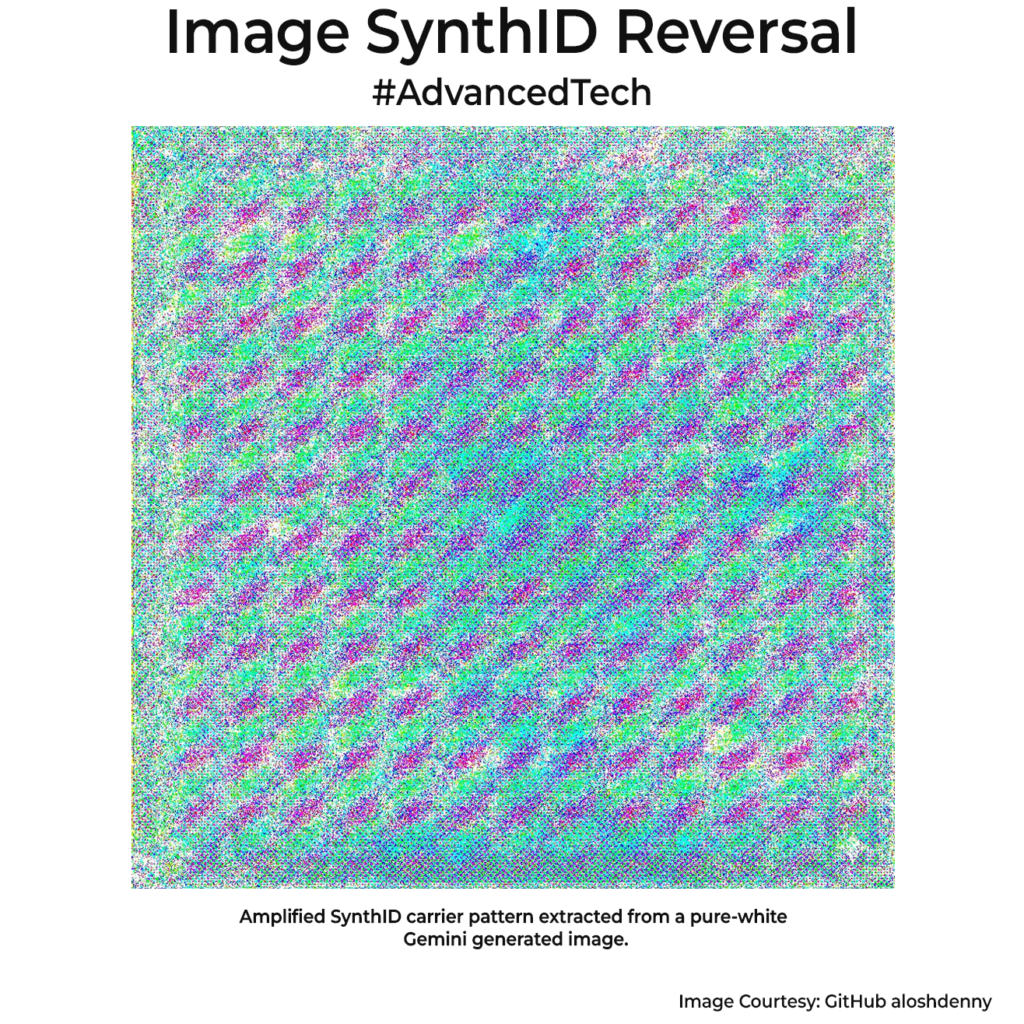
So now you have look at the image from the frequency domain PoV. An FFT views an image as slow and fast spatial patterns instead of only pixel values. If the watermark has repeated structure, it may show up as carrier-like energy at certain frequencies. Based on experimentation, these patterns change with resolution of created, and that phase consistency across simple images helps separate watermark-like signal from normal image content. That is the core idea.

The removal side is based on the same idea. Once they have isolated watermark-related frequency patterns, they apply small image transformations and spectral adjustments designed to weaken those patterns while keeping the image visually similar. This can reduce detector confidence. Its like adding noise to a pattern so that detector cant detect it accurately. These are for image creations, similar breaking patterns emerge for AI generated text too.

Google has disputed these claims, so I would not call this a full crack. Still, it is an interesting example of how AI watermarking is becoming a signal-processing challenge as much as an AI one. I think watermarking and watermark stress-testing will become an hot research area.
If you liked the post, Share it with your friends!

Advanced Tech: Microfluidic cooling

During some reading, I came across a cooling technology Microsoft published a few months back, and it felt somehwat more interesting than the usual “AI hardware” headline. The work focuses on cooling directly into the silicon itself.

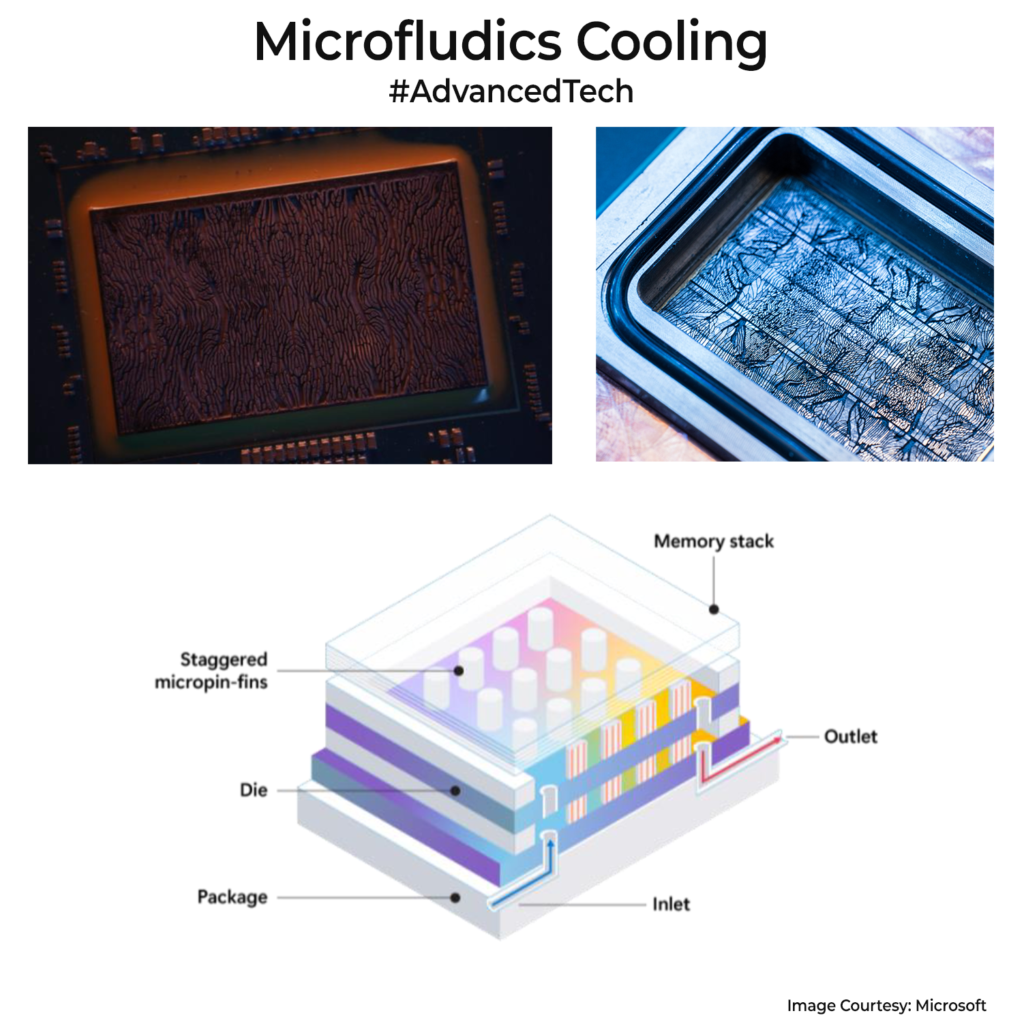
To understand why this is important, we need to understand how chips are cooled today. Most high-power processors rely on cold plates where coolant flows through channels above the package, while heat still has to travel through silicon, thermal interfaces and packaging layers before reaching the liquid. So additional layers adds thermal resistance, and as chip power density keeps increasing, cooling becomes a bottleneck.

What Microsoft is exploring are microfluidic channels etched directly into the back of the silicon so coolant moves much closer to hotspots on the die. The interesting part for me is the leaf-like channel structure they discussed. Chips do not heat uniformly, so a simple straight-channel layout is inefficient. A branching structure inspired by leaf veins distributes coolant more intelligently toward hotter regions while avoiding unnecessary flow elsewhere. I think they modeled channels with some AI patterning customized to each chip based on the heat produced, mimicking how leaf veins move water/nutrients via branching.

In Microsoft’s lab-scale testing, this reportedly improved heat removal by up to 3x compared to conventional cold plates and reduced maximum GPU silicon temperature rise by as much as 65%, although I would still treat these as controlled research numbers rather than production ones.

Training and inference clusters already consume massive power. Data centres used ~486 TWh in 2025. In inefficient setups, cooling alone can cross 30%, about 146 TWh, enough to power ~12.5 crore Indian homes for a year.

I think the solution in its current format would have reliability issues. Moving coolant this close to silicon introduces risks around clogging, leakage & pressure balance. A tiny blockage inside microscopic channels can impact an entire hotspot region. It might be a while before this rolls out in production.

If you liked the post, Share it with your friends!
1 2 3 4 5 96